Hey folks! So Politics of the Westerlands, Part I is done and will be up on Monday, and work is underway on Part II and Jaime II. In the mean time, what do we have on the Tumblrs? On Steffon Baratheon and the Southron Ambitions Conspiracy. The Baratheons as “backup Targs.” A long debate on Jaime and Tyrion’s complicity in the Lannister regime: Part I Part II Part III Part IV Part V Dorne and…
Jack Cade was a fascinating character. We know almost nothing about him personally, except that he was from Kent, and that he sometimes used the name John Mortimer, which some people at the time thought suggested a claim to the throne of England through Edmund Mortimer, Earl of March, the heir presumptive to Richard II, and part of Richard Duke of York’s claim to the throne. (Another reason why some people then and now think he was working for the Yorkists.)
We do know a good deal about why Cade’s Rebellion happened because he published a manifesto in 1450 – which by itself suggests that he was either educated himself or as others have suggested that he was working with Yorkists – called “The Complaint of the Poor Commons of Kent.”
The Complaint is a fascinating look at the politics of the immediate pre-Wars of the Roses period. It’s a classic bit of “evil councilors” political rhetoric, blaming the ills of England on the fact that the king is surrounded by “insatiable, covetous, malicious persons that daily and nightly are about his highness, and daily inform him that good is evil and evil is good” and setting forth a list of grievances:
The evil councilors are trying to undermine the law by persuading the king that “our sovereign is above his laws to his pleasure, and he may make it and break it as he pleases, without any distinction.” The manifesto states bluntly that “the contrary is true.”
The evil councilors are trying to smear commoners as pro-Yorkists.
The evil councilors are robbing the king by advising him not to collect his normal incomes, because they’re either getting the king to give the incomes to them or to people who’ve bribed them.
The evil councilors won’t let anyone come before the king without paying bribes.
The evil councilors are falsely labelling people as traitors to take their lands and goods, while protecting real traitors whose assets should be seized to pay off the royal debt.
The evil councilors are corrupting the courts to the point where “the law serves of nought else in these days but for to do wrong.”
The evil councilors are incompetent at their jobs, such that “his false council has lost his law, his merchandise is lost, his common people is destroyed, the sea is lost, France is lost, the king himself is so set that he may not pay for his meat nor drink, and he owes more than ever any King of England ought.” (I.E, injustice and a breakdown of law and order, a declining economy and burdensome taxes, defeat in France, piracy and French raids along the English coast, and high levels of royal debt.)
The evil councilors are threatening to seize “gentlemen’s goods and lands in Kent and call them rioters, and traitors and the king’s enemies,” just because the Duke of Suffolk who Parliament impeached for incompetence and who the King protected, got beheaded by TOTALLY UNKNOWN PERSONS and just happened to wash up at Dover.
We want everyone to know that we’re only against the evil councilors, and totally insist on everyone being tried under law.
We want everyone to know that we’re not going to rob anyone while we’re rebelling, honest.
We want the Duke of Suffolk’s supporters removed from government and replaced by the Duke of York and his followers.
We want the King to send a royal commission to Kent to investigate corruption.
So as you can see, the manifesto is pretty Yorkist in tone, but it’s pretty authentically rooted in complaints about the direction of public policy in 1450. And it was enough to get 5,000 men to take up arms behind Jack Cade.
Jack Cade then defeated the royal force to put down his rebellion at Sevenoaks, marched into London and declared himself Lord Mayor, and then had James Fiennes (HIgh Sherriff of Kent, Constable of Dover, Warden of the Cinque Ports, Lord HIgh Treasurer of England, Baron Saye and Sele, and a major supporter of the Duke of Suffolk) and his son in law put on trial and executed for treason.
Unfortunately for him, Jack Cade and his men got drunk and started looting the city, at which point the people of London got sick of him, closed London Bridge against him and fought a pitched battle to hold the bridge, which caused Cade to retreat having suffered heavy casualties. Cade was then persuaded by Archbishop (and Lord Chancellor) John Kemp to disperse his army, issuing general pardons and promising to fulfill the Complaint’s demands.
Henry VI then revoked those pardons and put a 1,000-mark reward on Cade’s head, who was tracked down and mortally wounded. His body was given a mock trial and beheaded, then quartered so that his limbs could be sent to various cities in Kent as a warning to anyone else who got ideas.
As to why you haven’t heard more of him, he was immortalized in Shakespeare’s Henry VI, Part 2.
Weird question but I’m from Australia, so I always wondered when you’re reading the characters in ASOIAF do you imagine them as British or as American? Also when you are imagining them speaking would they have a British accent similar to the show or do they speak with an American accent?
Also probably he’s never talked about it but has anyone ever asked grrm this question?
That’s a really good question. I definitely don’t think of them as speaking with American accents, but I’m not sure whether I think of them speaking with a British accent either. I’m not a fan of the audiobooks, so I don’t have that association either.
I wasn’t able to find a definite quote from GRRM himself, but people have pointed out that some of his writing tics – m’lord and my lord – fit a British accent but not an American accent.
I suppose it depends on whether you care about wealth for its own sake, or whether you’re more interested in power…
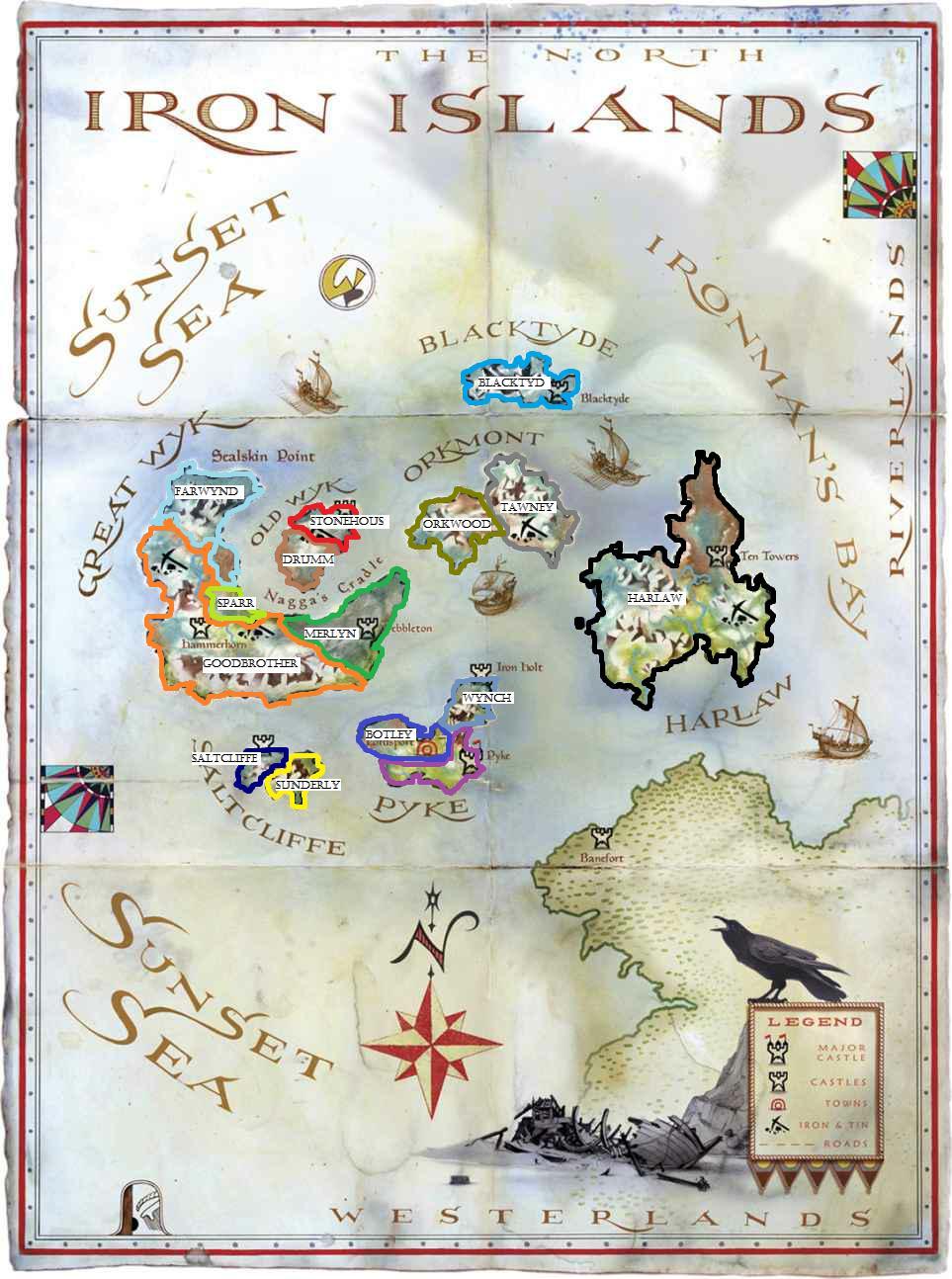
As for the Priests of the Drowned God, remember that their entire ideology is based around the idea that ornamentation is unmanly and un-Ironborn unless you pay the Iron Price – and priests aren’t reavers.
Bit of both. Beric Dondarrion is the leader who “escapes” seemingly impossible traps, Anguy’s the amazing archer, Thoros is the Friar Tuck, Lem Lemoncloak is Wil Scarlet and a bit of Little John.
Hey folks, if you’d like to read Politics of the Seven Kingdoms, Part V in one glorious post instead of two separate ones, it’s now up at Tower of the Hand. Check it out!
The Southron Ambitions/Rebel Alliance: Robert had already won the allegiance of the North, the Vale, the Riverlands, and the Stormlands. That’s half the continent right there, and even more so when Robert marries Cersei and gets the Westerlands as well. So it wouldn’t be seven kingdoms again, it would be one massive kingdom and a bunch of smaller states trying to avoid reconquest.
Institutional Inertia: The Seven Kingdoms have been part of one consolidated monarchy for almost three hundred years, less so for Dorne. That’s three hundred years with very few wars by historical standards, internal trade, law and order, all that good stuff. So people are going to be somewhat wary of going back to being warring kingdoms, especially after a rather bloody civil war which they lost.
Targaryen Legitimism: even if the rest of the Seven Kingdoms wanted to start something, independence is unlikely to be the case because the Targaryens are still kicking around in Essos – as long as their kinsmen are available to be restored to the Iron Throne, the Martells aren’t about to declare themselves independent again.
Internal Politics: This leaves the Reach, and they’re probably the most viable candidate for an independent state given their large army and economy, although it wouldn’t be easy trying to defend themselves on the Westerlands, Riverlands, Crownlands, and Stormlands borders at the same time. But the problem is that the Tyrell claim on Highgarden runs through the Targaryens – if the Reach isn’t part of Aegon’s realm, that claim isn’t good any more and the “Oakhearts of Old Oak, the Florents of Brightwater Keep, the Rowans of Goldengrove, the Peakes of Starpike, and the Redwynes of the Arbor” have every reason to claim the Oakenseat for themselves.
If Volantis was destroyed would that reroute traffic to slaver’s bay?
Probably not. Keep in mind, the economies of Essos are fairly specialized. In this case, the cities of Slaver’s Bay act as processors of the human raw materials that the Dothraki extract, and sell them to the Free Cities:
“For centuries Meereen and her sister cities Yunkai and Astapor had been the linchpins of the slave trade, the place where Dothraki khals and the corsairs of the Basilisk Isles sold their captives and the rest of the world came to buy.” (ADWD, Dany III)
Of the Free Cities, Volantis was their largest customer. Thus, Dany’s anti-slavery crusade has had two effects. First it’s terrified the slaveowners of Volantis into electing a tiger majority and going to war against free Meereen:
“The best calumnies are spiced with truth,” suggested Qavo, “but the girl’s true sin cannot be denied. This arrogant child has taken it upon herself to smash the slave trade, but that traffic was never confined to Slaver’s Bay. It was part of the sea of trade that spanned the world, and the dragon queen has clouded the water. Behind the Black Wall, lords of ancient blood sleep poorly, listening as their kitchen slaves sharpen their long knives. Slaves grow our food, clean our streets, teach our young. They guard our walls, row our galleys, fight our battles. And now when they look east, they see this young queen shining from afar, this breaker of chains. The Old Blood cannot suffer that. Poor men hate her too. Even the vilest beggar stands higher than a slave. This dragon queen would rob him of that consolation.” (ADWD, Tyrion VI)
The other effect that it’s had is to raise the price of slaves by massively cutting the supply. Hence why in ADWD, you see slavers being so greedy and reckless as to kidnap wildlings and try to sail through Braavosi waters, because the pure profit is worth the risk of being hanged.
Thus, if Dany attacks and captures Volantis, the economic effect will be to massively curtail the demand for slaves, by removing one of the biggest markets for slaves in all of Essos – because Lys, Myr, and Tyrosh aren’t big enough to pick up the excess. Which may be enough to break the slave system throughout Essos…


 RFTIT Tumblr Backup