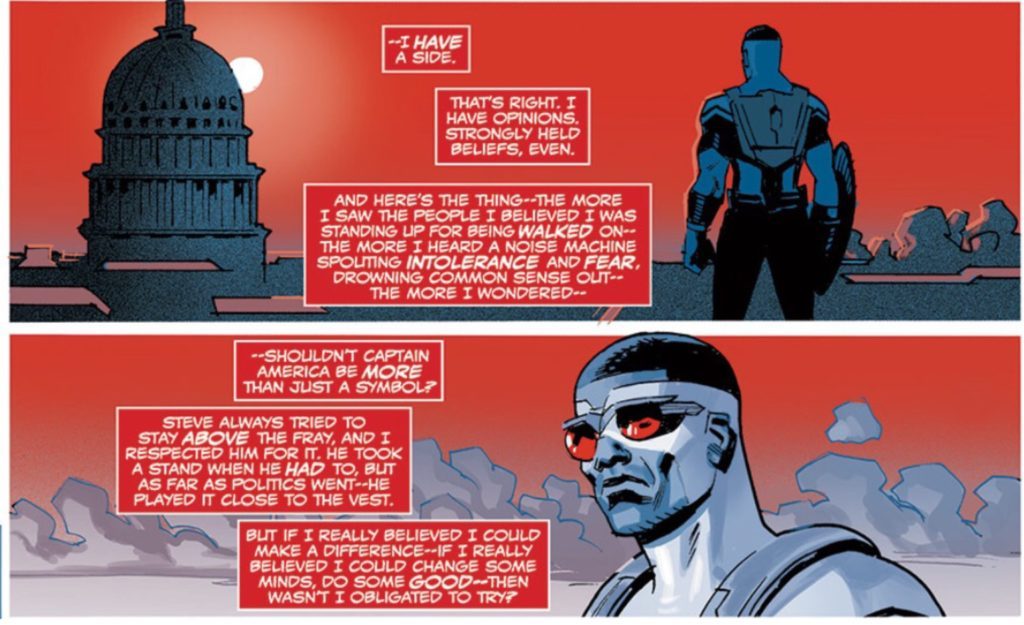
The problems begin far earlier than Spencer’s controversial retcon of Steve Rogers as a secret Nazi (HYDRA-Cap) in Captain America: Steve Rogers #1. In 2015, Spencer launched his first Cap book: Captain America: Sam Wilson #1, in which Sam Wilson (formerly the Falcon), took on the name while Steve was incapacitated. The opening conflict of CA:SW was premised on the idea that until Sam took over, Cap was non-partisan—is; Cap had no political stance. From here, the narrative struggles with whether it’s right that Sam-as-Cap is partisan, insofar as a superhero rescuing border crossers from white terrorists is “partisan.”
The trouble is that this narrative is hinged on the idea that until now, Cap was not political. Apart from being historically untrue, it speaks to a greater failure in recognising that everyone is political. The privilege to believe you can be apolitical is particular to a demographic like Nick Spencer’s. These people are exnominated, a term coined by Roland Barthes to describe how privileged identities are unnamed because they are the norm. The exnominated can believe that their race, ethnicity, gender, sexuality, bodies, and ideologies are “neutral.” For those of us outside the exnominated—anyone who is “other” in some way—our every action and inaction is, whether we like it or not, read as political. This is how the term “identity politics” arises, because only the non-privileged have a visible “identity,” and its existence is treated as political. Because we have been forced to recognise how our everyday is political, we recognise that the same is true of the exnominated. Not only is Captain America always-already political (come on, his name is “Captain America”), Steve Rogers, like every one of us, is always-already political. To believe otherwise is simply ignorant. It results in a fundamental flaw in the foundation of Spencer’s Captain America books and a lack of social understanding that is necessary for good writing.
To agree to the very premise that someone is apolitical is to validate the power structures that hold these people above others. To believe that one’s privilege is “neutral” is to misidentify oneself in the middle of a political spectrum, with marginalised people at one extreme and, inevitably, those who stand for the elimination of marginalised people at the other. This is how a mistake like HYDRA-Cap happens. First, Spencer asks us to agree to the flawed premise that Sam Wilson is more political than Steve Rogers. To do this, we must ignore Steve’s outspoken leftist leanings since the Silver Age and assume that neutrality is both possible and in-character. If we have agreed in Captain America: Sam Wilson that Steve is “neutral,” Steve’s political identity is hollowed out for a Nazi origin story in Captain America: Steve Rogers #1. Nazism becomes a reasonable part of the spectrum, and it happens because Spencer has built this narrative logic into his work from the beginning.
I’ve discussed this before here, but given their level of technology and literacy, Essos must have more of an education system than is shown in the text.
There’s a couple possibilities:
Greco/Roman slave-tutoring: this fits the Free City’s social structure, even if that social structure isn’t super well-suited to their level of technology but w/e. Well-educated slaves tutoring the elite philosophy, rhetoric, and the rest of the trivium and quadrivium is certainly a long-lasting “successful” model of education, so there you have it.
Local Academies: This is more likely in Braavos and Braavos-centric cities that don’t have slavery. I wouldn’t be surprised if the Essosi academies are A. more focused on Valyrian “humanism” as opposed to the Citadel’s relentless focus on empiricism, and B. more focused on applied sciences needed for finance, commerce, and high-end manufacturing than the Citadel’s trade-school-approach to feudal administration.
It’s just not very well-set up in his previous characterization: from the beginning, Scott Summers has been one of those “emotionally repressed, …Type-A…personalities,” I talk about not working as well in the present, which is part of the reason why he has such a big hatedom.
Now, unlike Reed, Summers has historically been more of a follower than a leader – Xavier’s teacher’s pet and hall monitor, the eternal Leonardo to the Raphael/Michelangelo antics of Bobby and Hank (and Warren, sometimes) – but very much a rules-following, by-the-book guy. And the main thing that made him more than a total wet blanket was his Teen Romance-style angst about whether Jean could ever love a man who shot red eye-beams. So to sum up: Scott Summers = dutiful and into romance.
Now, I think there was a way that Claremont could have leaned into the Mr. Vice Guy thing, but didn’t quite: namely, actually exploring Scott’s tendencies to have low-stakes, no-labels affairs the moment he thought Jean was dead/not around (thinking about Colleen Wing, Lee Forrester here) as a way to introduce the idea of Scott straining against his own repression and feelings of being trapped in his role as Designated X-Men Team Leader, and then build up from there to establish Scott Summers as one of these heroes with feet of clay (in his case, a tendency to default to following others’ expectations of him despite not really being fulfilled by the life that results in, and then a reactive tendency to try to wreck his own life in a search for independence and self-knowledge):
But there’s not really any follow-through. Scott and Jean never have a chance to talk through this tendency and how it reflects on his feelings about Jean (even though they’ve got one of those creepy psychic-link-true-love things going on which means she knows and he knows she knows) or what he wants from life beyond being her boyfriend and an X-Men. Nor does anyone really call him out on his hypocritcal jealousy around Jean Grey and other dudes (although one time it was Mastermind, so I guess you get a pass there), or really call him out about about dumping Madelyn (granted, a lot of that was the fault of Fall of the Mutants and Inferno, but still).
Sidenote: I’ve never had a problem with Spiderman being married and, yes, him getting a divorce works so much better than diabolic annulment.
“We speak of Nine Free Cities, though across the width of Essos one may find many other Valyrian towns, settlements, and outposts, some larger and more populous than Gulltown, White Harbor, or even Lannisport. The distinction that sets the Nine apart is not their size but their origins. At their height before the Doom, other cities, such as Mantarys, Volon Therys, Oros, Tyria, Draconys, Elyria, Mhysa Faer, Rhyos, and Aquos Dhaen were grand and glorious and rich, yet for all their pride and power, none ever ruled itself. They were governed by men and women sent out from Valyria to govern in the name of the Freehold.”
“Such was never true of Volantis and the rest of the Nine. Though born of Valyria, each was independent of its mother from birth. All but Braavos were dutiful daughters, neither making war upon Valyria nor defying the dragon lords in any matter of significance; they remained willing allies and trading partners of their mother and looked to the Lands of the Long Summer for leadership in times of crisis. In lesser matters, however, the Nine Free Cities went their own ways, under the rule of their own priests and princes and archons and triarchs.”
Sure! They’re an exaggerated omnicidal version of the Unseelie Court, aka the Bad Faeries, to the Children’s Seelie (or Summer) Court.
The faeries of the Seelie Court are rarely presented as an unambiguous good from the perspective of their human neighbors, and neither are the Children. The Unseelie Court and its various inhabitants, however, bring the true nightmares. They require no offense from humanity before attacking (check), they regularly abduct humans into their Horde (check), they enjoy toying with mortals and occasionally taking a particular one as pet (check), and they’ve been known to transform mortals into faeries (possible check).
Of course, the Others are considerably more destabilizing to the overall cycles of nature than your traditional Bad Faeries, so one must also reckon with the enormous influence of Terry Pratchett, felt all over ASOIAF but especially in the echoes of Pratchett’s Elves in GRRM’s Others:
A land of ice…
Not winter, because that presumes an autumn and perhaps one day a spring. This is
a land of ice, not just a time of ice.
And three figures on horseback, looking down the snow covered slope to a ring of
eight stones. From this side they look much bigger.
You might watch the figures for some time before you realised what it was about
them that was strange-stranger, that is, than their clothing. The hot breath of their
horses hung in the freezing air. But the breath of the riders did not.
“And this time,” said the figure in the centre, a woman in red, “there will be no
defeat. The land will welcome us. It must hate humans now.”
“But there were witches,” said one of the other riders. “I remember the witches.”
“Once, yes,” said the woman. “But now…poor things, poor things. Scarce any
power in them at all. And suggestible. Pliant minds. I have crept about, my deary. I
have crept about o’nights. I know the witches they have now. Leave the witches to
me.“
"I remember the witches,” said the third rider insistently. “Minds like…like
metal."
"Not anymore. I tell you, leave them to me.” The Queen smiled benevolently at the
stone circle.
“And then you can have them,” she said. “For me, I rather fancy a mortal husband.
A special mortal. A union of the worlds. To show them that this time we mean to
stay."
"The King will not like that."
"And when has that ever mattered?"
"Never, lady."
"The time is right, Lankin. The circles are opening. Soon we can return."
The second rider leaned on the saddlehorn.
"And I can hunt again,” it said. “When? When?"
"Soon,” said the Queen. “Soon."
“Elves are wonderful. They provoke wonder. Elves are marvellous. They cause marvels. Elves are fantastic. They create fantasies. Elves are glamorous. They project glamour. Elves are enchanting. They weave enchantment. Elves are terrific. They beget terror. The thing about words is that meanings can twist just like a snake, and if you want to find snakes look for them behind words that have changed their meaning. No one ever said elves are nice. Elves are bad.”
Which I remember hitting me like a sledgehammer in the way it elegantly showed how so many of these accolades suggesting beauty, fame, and art have their roots in magical thinking and an instinctive terror of the nobility.
Well, I think you either lean into the rich 70s melange of aliens, cosmic forces, secret societies in fetish-wear copied from The Avengers (UK), allegories about the danger of repressing women’s sexuality and power, crash-landing space shuttles, the Blue Side of the Moon, or you don’t.
But in so far as it’s related to the social commentary…well, it’s there in places but it’s not in the foreground:
Jean becomes Phoenix only because the U.S national security state bankrolls Steven Lang’s genocidal Sentinel program, which sets up the aforementioned space shuttle, at a time of intensified “anti-mutant hysteria,” includeding the firebombing of Judge Chalmers’ house.
The Hellfire Club as a metaphor for social class and the failure of intersectionality – they’re mutants who are basically pushing the Sentinel program, because they’re so rich and powerful they think they’re above oppression.
The cold war between Xavier’s and the Hellfire Club over the soul of Kitty Pryde as a metaphor for whether the Youth of the 70s would follow the idealism of the 60s social movements or selfish Yuppieism/proto-Reaganism.
Dazzler the Movie and those shenanigans are bang in the middle there.
And of course, Days of Future Past lands right after it ends…
Here’s how it fits into the larger thing: if all the X-Men are allegories, if they’re just “representatives of the oppressed” and nothing else they don’t work. You have to start with character – are these heroes people we care about and identify with? – otherwise they’ll come off as cardboard cutouts rather than real people and no one will care about their fictionalized oppression. So the hook, to me, is that the X-Men are super-heroes that, unlike the Avengers or the Fantastic Four, face oppression – but you need both parts: yes, the Sentinels and the Hellfire Club and Genosha and everything else, but also the Shiar and the Juggernaut and giant dragons over Tokyo and the Asgardian Wars, and the Dark Phoenix Saga.
So to me, what makes Dark Phoenix Saga important to the X-Men is that it gives Jean Grey and Scott Summers a emotional arc with weight and depth – it makes them real people.
omg are the hellfire club neoliberalism
Yeah, pretty much:
With the exception of Donald Pierce, who really should never have been given a membership, they’re all mutants with passing privilege who are willing to promote the Sentinels – up until Nimrod shows up and scares the crap out of them – because it promotes their personal interests; they have no connection to the broader mutant community, let alone the Morlocks.
They’ve got that 70s thing of cashing in on the sexual revolution but not the feminist movement or the gay rights movement – the women all get to dress as fetish maids and dommes, but the men are all in their anachronistic-faux-regency-suits which keeps everything safely hetero. (There was a reason why even Warren Worthington III called them “stuffy, yet risqué.”)…although I’ll bet Sebastian Shaw was into some weird-topping-from-below-Samson stuff, given how often he liked to take off his shirt and get punched by big strong guys.
They’re definitely in the 1%. A Club House on Central Park, Shaw Industries, Frost International, Harry Leland’s a corporate lawyer, etc. As Neil Shyminsky put it: “The Hellfire Club isn’t planning to take over the world. One gets the impression that they don’t need to because they already control it.”
I’ve always felt that there was a fundamental ambivalence about what Madelyn Pryor was supposed to be for: is she the impetus for Scott Summers to mature and start a new life outside the X-Men as a husband and a father (which if so is really complicated by having her be an identical twin of Jean, because it starts their relationship off on such a fragile foundation), or she she supposed to be part of some grand conspiracy (whether that’s the Dark Phoenix and Mastermind or Mr. Sinister and cloning or Hell invading NYC)?
Yes, the bigger problem was Busiek coming up with the clone loophole for Jean Grey’s death-because-of-genocide thing, but Claremont’s hardly innocent here – her being an identical twin was always going to get people talking about clones and whatnot, likewise all of his shenanigans about Jean dying and Madelyn being reborn at the exact same second was way too obvious a phoenix metaphor. If Madelyn was going to be Cyclops’ cosmic consolation prize and nothing else – which is a bit creepy, when you think about it – just have her be a different woman! I mean, Lee Forrester is pretty awesome and X-Men artists don’t have a hard time drawing her as distinctly different…
But the biggest mistake, IMO, was having Scott react to Jean’s rebirth by leaving his wife and baby to chase after Jean and pal around with his old school chums in X-Factor – leaving aside whatever you think about Claremont’s ideas about characters needing to age out of the X-Men, on a personal level, that’s some profoundly unheroic behavior. Pretty much everyone from Claremont on down has said after the fact that they didn’t think this through, although I would argue that there were ways to turn into the skid if you weren’t set on the idea of Scott coming out of this ok – after all, Jason was a hero, and look what happened to his first marriage…
On the other hand, as convoluted as it was – and it definitely it could have used a few less moving parts – Inferno was a hell of a way to resolve the tangle, an ambitious as hell decision to turn everything up to 11 and just guitar solo your problem away. (Even if it did involve Madelyn Pryor getting hit with every single gendered stereotype – woman scorned, evil witch, why’s she killing her baby again?, etc. etc. – imaginable.)
But if we could do it over again…
I think the main thing I’d do is to not start from a position that Scott and Jean Are Fated To Be Together. Jean dying, whether she comes back as a clone or what, should be a big line in the sand when it comes to their relationship – he saw her die in front of him, there’s the legacy of the Phoenix and the Dark Phoenix that will always be between them, things could never be the same. So maybe Scott doesn’t leave his wife and kid. Maybe Jean Grey gets to move on and have relationships outside the guys she went to a boarding school with when she was a teenager, and maybe she gets to explore rather than repress huge parts of her personality that she never could while Xavier was keeping a psychic bomb confined in her skull.
Another thing I’d do: embrace consequences. Rather than just trying to kill the hypotenuse so you can have Scott, Jean, and Nathan as a “normal” nuclear family (because it’s not a normal family, time travel and cloning creeps back in, and that’s how you get Cables), why not have Scott lose his shot at happiness with Jean as a way of signalling that maybe what he did to Madelyn and Nathan wasn’t ok? Or maybe Madelyn just takes her son with her, rather than going through the whole Madea plot, because he’s her son and Scott abandoned them (now I’m getting Hamilton and Les Mis scrambled in my brain)?
Or at the very least, how ‘bout everyone has an awkward but open conversation about the dysfunctional dynamics off the Summers-Grey-Pryor clan? Maybe puppets are needed to get across that Jean is kind of interested in trying out BDSM and might not want to become a surrogate mom right now, Scott, or to get Alex to open up about why he keeps becoming romantically interested in manipulative women who remind him of his brother’s ex, or why Scott develops commitment issues around powerful women and then goes off looking for women who resemble his mother-
no, please, use the puppets not the mutant powers…


 RFTIT Tumblr Backup