Couldn’t Robb have just sent ravens north ordering lords to gather and re-take Moat Cailin from the north? The Mandelys alone could probably have done so.

twodotsknowwhy:

racefortheironthrone:

Robb could have sent the ravens, but the question is who would have gotten them? 

Winterfell had fallen, so there’s no Stark to coordinate the reconquest; the Northern lords are thoroughly distracted by the Hornwood Crisis and even when they get past that, the failed attempt to retake Winterfell further scatters the loyalist forces.

These are all dominos that have to fall for the North to fall, because as we see in ADWD, even with everything going against them, the Northmen still put Moat Cailin under siege, with the crannogmen attacking from the south and the Ryswells and Dustins from the North, and then Ramsay and Roose coordinating from north and south of the Moat. If Winterfell had not fallen or had been recaptured, Moat Cailin would no doubt have fallen faster. 

The only armies the north has left in the north is garrisons left behind to protect their castles. Theon was able to capture Winterfell by attacking the coast and drawing the garrison away from Winterfell. After that happened, I cant imagine Manderly wanting to send his garrison to take back Winterfell, thus leaving White Harbor undefended. Especially because 1) White Harbor is, well, a harbor and therefore much more susceptible to an Ironborn attack and 2) the only reason Theon was able to take winterfell in the first place was because no one was expecting it, without a robust offense or the element of surprise, retaking winterfell would be next to impossible.

^ This isn’t quite accurate.

When Theon captures Winterfell, Rodrik Cassel is able to throw together an army of 2,000 men in short order, including 600 men from Winterfell, but also 300 Cerwyn men, and 1,100 men from the Tallharts, Hornwoods, Flints, and Manderlys, who provide “a dozen barges upriver packed with knights, warhorses, and siege engines.”

Add to those 2,000 another 3,500 from the hill clans – Wulls, Norreys, Liddles, Harclays, Flints, and Burleys – who show up to help Stannis take Deepwood Motte, plus another 450 Karstark men, 400 Umbers, and an unknown number of Mormonts and Glovers who join Stannis’ army after Deepwood Motte. 

That brings us up to 6,350 men. Add to that the forces of House Manderly that Wyman held back at White Harbor (he brings only 300 men to Winterfell) – the fighting men of the warships he’s hidden up the White Knife, the “more heavy horse than any lord north of the Neck,” the dozen petty lords and hundred landed knights. 

So it’s not that the North is out of fighting men, it’s that its fighting men are disorganized, split between many different factions, and lacking central leadership to bring them together into one force and point them in the same direction. 
Couldn’t Robb have just sent ravens north ordering lords to gather and re-take Moat Cailin from the north? The Mandelys alone could probably have done so.

Robb could have sent the ravens, but the question is who would have gotten them? 

Winterfell had fallen, so there’s no Stark to coordinate the reconquest; the Northern lords are thoroughly distracted by the Hornwood Crisis and even when they get past that, the failed attempt to retake Winterfell further scatters the loyalist forces.

These are all dominos that have to fall for the North to fall, because as we see in ADWD, even with everything going against them, the Northmen still put Moat Cailin under siege, with the crannogmen attacking from the south and the Ryswells and Dustins from the North, and then Ramsay and Roose coordinating from north and south of the Moat. If Winterfell had not fallen or had been recaptured, Moat Cailin would no doubt have fallen faster. 

If Cersei had turned out to be infertile, would Robert aim to remarry or legitimise Edric Storm? Also what would Tywin and Cersei have done in this situation?

That’s a good question.

I think the politics would get very complicated. Siring an heir is a vitally important task of a monarch, especially a monarch of a very young dynasty – to quote Hillary Mantel, “if a king cannot have a son…it matters not what else he can do. The victories, the spoils of victory, the just laws he makes, the famous courts he holds, these are as nothing” – so there would be pressure on Robert to have a son, which would mean putting Cersei aside.

On the other hand, there would also be counter-pressures: Robert has two brothers to stand as heirs, which means that the dynasty as a whole is in less danger than his own personal line is and that both Stannis and Renly have an incentive for Robert not to sire an heir; House Lannister is politically important in the broader political coalition that supports the new regime, so setting them aside is potentially dangerous.

The big question that would need to be answered here is: if not Cersei, who? This is an area where @goodqueenaly is more knowledgeable than I am, so I’ll toss this over to her. 

During a recent re-read of ADWD I made sure to remind myself to ask you: where do whores go? More specifically, while we know Tysha is on Tyrion’s mind, why Tyrion does ask so many people? Is it his way to get a read on their personality while sort of working through his issues? That’s my best guess. I also assume Lys is the most ‘face value’ answer to the question but if you have another I would also love to hear that!

Nowhere. Tywin wasn’t giving Tyrion a clue, he was dismissing Tysha’s entire existence as unimportant, of no consequence. 

Tyrion asking people this is entirely about trauma, hence why he’s also constantly hearing the sound of the crossbow firing. As fans we often don’t think abotu that while there was an 11 year gap between ASOS and ADWD, it’s onlly been about a week for Tyrion between him finding out the truth about Tysha, murdering Shae and his father, and then arriving in Pentos. Especially in Tyrion I, he’s profoundly fucked up over what he did and what was done to him, and the words are a way that he revisits those memories; notably, the more time passes in ADWD, the less frequently he asks that question until he stops altogether. 

Do you think it’s likely that the House Royce are one of the “Dozen” houses that keep the Old Gods? Their pride at their first men roots and the words “We Remember” would indicate to me that they do. Yes, they have a history of Knighthood, which is associated with the seven, but so do the Blackwoods

This is something that people have gone back-and-forth on a lot in the fandom. There’s not a huge amount of evidence either way: the Royces don’t come up that often in the series, and never at the same time as mentions of the Old Gods or the Faith of the Seven. They practice the knightly traditions of the Vale, but there’s sufficient evidence of Old God-worshipping knights elsewhere that it’s not dispositive. In the same token, they are noted for their runic armor and their motto speaks to their pride in their roots as you say, but plenty of houses have managed to reconcile their family legacy with their new religion.

The one detail that makes me think they might be one of the dozen is that they’ve married into House Stark, and one of the things I think is noticeable about the Starks is that they almost always marry into Houses that worship the Old Gods, and when they don’t (almost exclusively Manderlys) that line tends to fade out rather than succeed to Winterfell, which I think is GRRM wanting to keep his Starks as First Men/North/Old Gods as possible. 

Sorry to drag the Punisher discourse back here, but – the most frustrating thing about this character and his fandom is the way people keep using his ‘you’re one bad day away from being me’ line. I know that’s a show thing, but – Matt has had a whole succession of bad days and will probably have more if the next season is going to deal with his comics-canon periods of homelessness. Still not killing. Jessica Jones, whose life was torture for months and who still has killed *once*, in desperate-

-circumstances, when there was no other choice. Luke Cage, who has been through *so much shit*, has lost family, has been unjustly imprisoned – genuinely unjustly, not ‘I don’t want to take responsibility for all those people I killed’ – and so many others. It’s just- It’s frustrating that this is never called out, because the *choice* to commit violent acts is important. Making it seem like something beyond control makes it something somehow above or below criticism and it’s so frustrating!

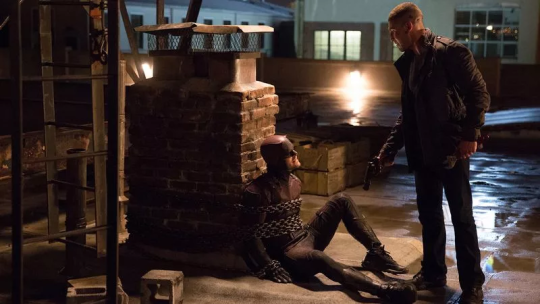
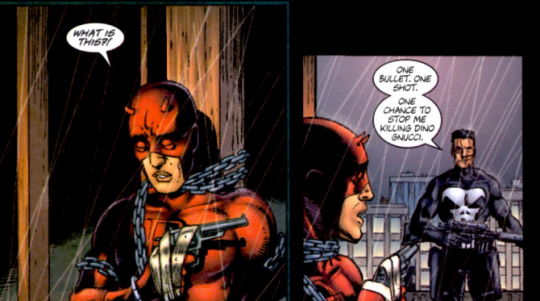
Good point. One of the things I liked about Daredevil Season 2, although there was plenty I didn’t like, was the way it inverted the whole scene where Punisher chains Daredevil to a chimney with a gun and has him choose between letting the Punisher kill someone or shooting the Punisher in the head. The original scene – written by Garth Ennis, one of my least favorite comic book writers ever – is supposed to show that the Punisher is right and Daredevil is a hypocrite and morally weak:

Ultimately, Daredevil pulls the trigger, only to find out that the Punisher removed the firing pin ahead of time so that he can both expose Daredevil as a moral fraud and kill someone at the same time. Because Ennis is always more interested in inflicting a humiliation conga on his antagonists than writing actually compelling storytelling. 

In the show, we get something far more interesting: Daredevil finds a third option, shooting the chain and freeing himself, stopping the Punisher in the nick of time, and then saving the Punisher’s life from an entire biker gang without killing anyone, by using the gun as a club and the chain as a flail. It’s a statement, that what makes a superhero is that they go beyond the limits in order to pursue justice while upholding their principles, by not taking the easy way out. 

How do you feel about Morbius the vampire?

I actually read some Morbius comics when I was a kid. He’s a weird character. 

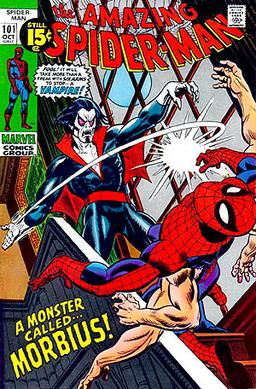
image

Some interesting things about Morbius:

  1. Morbius isn’t his super-hero name, it’s his actual name. Like Otto Octavius, Michael Morbius is one of those Marvel characters doomed by uncaring parents to a name of destiny
  2. Morbius is called “the Living Vampire” because he is not, technically speaking, one of the undead. He was never bitten by a vampire or drank their blood. Morbius became a “pseudo-vampire” by injecting himself with vampire bat DNA and electro-shocking himself in order to cure himself from a rare blood disorder…and in the process, scientifically reverse-engineered the quite real and supernatural vampirism that exists in the Marvel Universe. The ontological implications are fascinating.
  3. Morbius is originally a Spider-Man sympathetic villain, in the vein of the Lizard, although he’s since spent more of his career as part of the Midnight Sons, a supernatural team of horror-themed second stringers plus Ghost Rider plus Black Cat for some weird reason. 

While I love Morbius as an example of how 70s Marvel’s fad-chasing could sometimes result in a wonderful alchemy of cheese, that’s also why I’m really skeptical of the upcoming Sony film even if it wasn’t starring Jared Leto. In a similar but distinct way to the problems with a Venom movie, I have reservations both that the main character can sustain a movie because he’s not really built to be a main character (Morbius is kind of a one-note emo boy, and when he’s worked in the past it’s usually in an ensemble), and that he’s absolutely the wrong character to do a dark n’ gritty anti-hero movie with.

What is novel and unique about Morbius is that he is inherently ridiculous. He’s not a real vampire, he’s a mad scientist who thought that VAMPIRE BAT PLUS LIGHTNING = CURE. He’s a world-reknowned scientist who also voluntarily goes out of doors with a deep v-neck popped collar and underarm wings, because clearly the good doctor built his costume out of his old disco jumpsuit. He spends half of his time bemoaning that he must drink blood out of the necks of an attractive young woman from the cover of a Mills and Boon novel and the other half doing medical rounds as the only doctor in Monster Metropolis.

If this project was going to be done at all, it would have to be done in a deliberately campy and tongue-in-cheek fashion. And that’s not how Sony rolls. 

Thinking about Alaric Stark and the desire to preserve the Old Gods made me think of paganism’s disappearance from Christianized Europe. When and where was the last redoubt of indigenous religion in Western Europe?

Good question! 

I suppose the answer is whether by paganism you mean the organized, urbanized cults of the Greco-Roman world or the polytheistic religions of the non-Roman world.

Dating the decline of the former is a bit tricky: paganism certainly outlived Constantine I (although he did create certain barriers to pagan institutions); it was badly damaged under Constantius II, who pursued a more active program of anti-pagan legislation; Julian the Apostate lead to a brief restoration andf then relative toleration under Jovian, Valentinian I, and Valens; then Gratian and Theodosius started the anti-paganism machine up again; then there was a revival of paganism after the death of Theodosius, amd so on. Some scholars use 529 CE as the end-date, based on the closing of the Academy of Athens.

The latter persisted a lot longer. Charlesmagne was fighting Saxon pagans in the 8th century; when the Danes conquered northeastern England and established the Danelaw in the 9th century, with the last pagan king of Northumbria in the mid-10th century; Scandinavia took a long time to be Christianized and you see archaelogical evidence of paganism into the 13th century; Lithuana wasn’t Christianized until the 14th century; etc. 

Generally, the further east and north from the Mediterranean you go, the longer paganism held out.