The footnotes, definitely. The pictures – only the ones where I have the rights to them.
Author: stevenattewell
After the Reach, which kingdom would you say could call upon the most manpower for war? After reading your economic development profiles I was guessing the Westerlands due to their already developed nature and wealth.
See here.
I’m wondering about the population of the most far-flung petty regions in the realm. it seems like many houses like House Farwynd of the Lonely Light, House Umber, and House Mormont essentially rule only over themselves. Or am I misreading this and there are actual smallfolk in these locales?
Yeah, this is a misreading. The Farwynds rule over a group of thirteen islands far to the west of Ironman’s Bay, Bear Island has fishing villages and the like, and the Umbers have quite a few smallfolk who are needed for the harvest, etc.
Thoughts on Wonder Woman
Well, I went to see the movie I had been quite apprehensive about given its setting and it turns out…it’s one of the better superhero movies of the past twenty years, and so far above the rest of the DCEU that it kind of retroactively breaks MoS and BvSDoJ.
More spoilery thoughts below the cut.
Diana
Before they can do anything else, an actor playing a superhero has to sell you the physical plausibility of them being super-human (even the ones without powers still do stuff that’s super-human – there’s a reason Christopher Nolan filmed Batman like a monster in a horror movie). Gal Gadot did that in spades, delivering an astonishing physical performance that really made you believe she was a demigod.
Equally importantly, the script delivered a Diana that audience can like – she’s idealistic to a fault, she sees the best in people, she’s compassionate and brave and her basic instinct is heroic. And her flaws – she’s incredibly naive (although you definitely chalk that up to being raised in a utopia by a mother who shielded her from the truth about everything), her idealism often results in her seeing what she wants to see rather than what’s there, and as a warrior she often tries to brute-force the world into seeing it her way – are both non-dealbreakers and fit the story really well. Diana tries to save the world without understanding it, learns the truth about the world and herself, and ends up saving the world by understanding it.
And I’m very happy that for once, the fundamental lesson wasn’t a misanthropic one: Diana doesn’t conclude that humanity sucks and that superheroism is either futile or fascist, she sees the good and the bad in humanity and believes that love can redeem us. For a film that posits the literal existence of the Greek gods, it’s one of the most Protestant films ever: humans are inherently sinful despite our best efforts, and only by the grace of Diana are we saved.
As for the non-physical performance: I thought Gal Gadot did very well at all the comedic scenes, and had a nice rapport with the ensemble, and was quite convincing in scenes in which she was angry or determined. I didn’t buy her as much when she was supposed to be grieving or despairing – the scene in the gassed town for example fell flat.
Themyscira
I really liked this sequence – it was colorful, strange, the combat choreography was incredibly balletic and dynamic, I thought the way they dealt with Diana’s origin stories and the gradual reveal of her burgeoning powers was quite good.
In fact, I wanted to spend more time on the island and wish we could have seen Chris Pine – who did a great turn as Steve Trevor and really should be allowed to play more comedic roles than somewhat wooden leading man roles – interact with the broader Amazonian culture in the same way that Diana does with London. As it is, he really only experiences it through Diana.
London
I was less fond of this section. Visually, it’s incredibly monotone grey – how does the home front look less visually appealing than the trenches? – and outside of the shopping sequence it was generally rather exposition-heavy in a way that really didn’t illuminate very much. I have a sad feeling that if you polled people who watched the movie and asked them what an armistice was or why Ares was pushing for it rather than against it, most of them would be very confused indeed.
The Front
This is the part that I was the most apprehensive about, both because I was worried that the visuals of Diana going over the top and saving the day kind of re-writes the essential insanity of the Western Front – my great-grandfather fought at Ypres and no one there was passing around bullet-deflecting bracers or mortar-proof shields – and because making Ze Germans the baddies in WWI potentially re-writes the essential insanity of the alliance-builders and the war planners on all sides.
Thankfully, my fears were completely allayed. On one level, the action is just too well done – whatever intellectual position one holds, when Wonder Woman starts throwing tanks and knocking down sniper towers bodily, the adrenaline surge just overpowers that. But on another level, I felt that the filmmakers avoided the worst: they pointed to the shortcomings of the Entente through Sameer’s struggles with racial discrimination, Etta’s motioning towards the suffragette movement, and Chief’s pointed gestures to the history of American wars against Native Americans. Diana’s mistake wrt to Ludendorff and Ares and Trevor’s speech about how people cause wars due to having badness in them also points away from having one side be the Baddies.
And the final scene where we see young Germans cheering or sobbing in relief when they realize the war’s finally over was really important – I just kind of wish it was more consistent whereas 90% of the Germans we see before that were pretty stock faceless Baddies in stahlhelms.
But as far as individual Germans went, even Doctor Poison got humanized and who gives a damn if Ludendorff is slightly slandered? The man was a warmongering bastard proto-Nazi and both Germany and the world would have been better off if he’d died in 1918.
Ares
While the English side of his plan makes no sense, I actually liked David Thewlis’ bureaucratized, modern, seductive Ares – a god who changes with the times, like Vulcan on last week’s episode of American Gods – way more than when he started putting on pseudo-Greek armor.
The DCEU
Here’s where I think Wonder Woman kind of breaks Man of Steel and BvSDoJ: a big part of the premise of those two movies is that superpowered beings were completely new and literally alien and thus caused great fear and suspicion, requiring Superman to spend his life in hiding lest humanity something something.
But in this movie, hundreds of people saw a demigoddess in action a hundred years ago – and yes, the civilians in that one village got gassed, but there was a whole battalion of British soldiers who saw her deflecting machine guns and mortars and a whole base of German soldiers who saw her fly and hurl lightning bolts and pick up tanks. That’s not something that can be easily covered up.
And this is the problem that comes with trying to all of the sudden reverse-engineer a cinematic universe. Man of Steel makes sense in a world in which Superman is the only superhuman; the original idea of Batman fighting Superman in the wake of Man of Steel makes a certain amount of sense as well – but they don’t make sense in the context of a world in which Wonder Woman is a historical fact, and where superpowers are so common that Suicide Squad is a thing that can happen (thinking of Sorceress and Diablo here).
Rereading A Game of Thrones it kind of surprises me that there were no Northerners at all in the Hand’s Tourney except for Eddard’s guards. Not even Manderlys and White Harbor knights when they follow the Seven and practice knighthood. Do you suppose this is due to the Manderlys adopting the Northern disinterest in tourneys? In fact besides Ned’s household I don’t recall seeing any Northerners in King’s Landing or anywhere in the south before the war. The North seem detached from Westeros.
First, about jousting in general. According to WOIAF:
“As knighthood is rare in the North, the knightly tourney and its pageantry and chivalry are as rare as hen’s teeth beyond the Neck. Northmen fight ahorse with war lances but seldom tilt for sport, preferring mêlées that are only just this side of battles. There are accounts of contests that have lasted half a day and left fields trampled and villages half–torn down. Serious injuries are common in such a mêlée, and deaths are not unheard of. In the great mêlée at Last Hearth in 170 AC, it is said that no fewer than eighteen men died, and half again that number were sorely maimed before the day was done.”
In other words, Northmen don’t joust (much – Brandon Stark didn’t do too bad at Harrenhal, there’s Jorah Mormont at Lannisport) because they consider it too refined, too sanitized, too fancy, and boring to boot, whereas southerners consider Northern melees to be disorganized, disorderly, and insanely violent. It’s a nice continuation of the North/South cultural divide.
Second, about the Hand’s Tourney. The makeup of tourneys depends very much on the location and publicity of the event, and in this case the Hand’s Tourney was A. located down in the South, which means folks oop North are going to hear about it much later and have a hard time getting there, and B. a spur-of-the-moment decision of Robert’s, so there wasn’t the time to get the word out as much as there was for the Tourney at Harrenhal, for example. (Notably, in that latter tournament, the Starks were there in force, they brought their bannermen and companions, so there were way more Northerners)
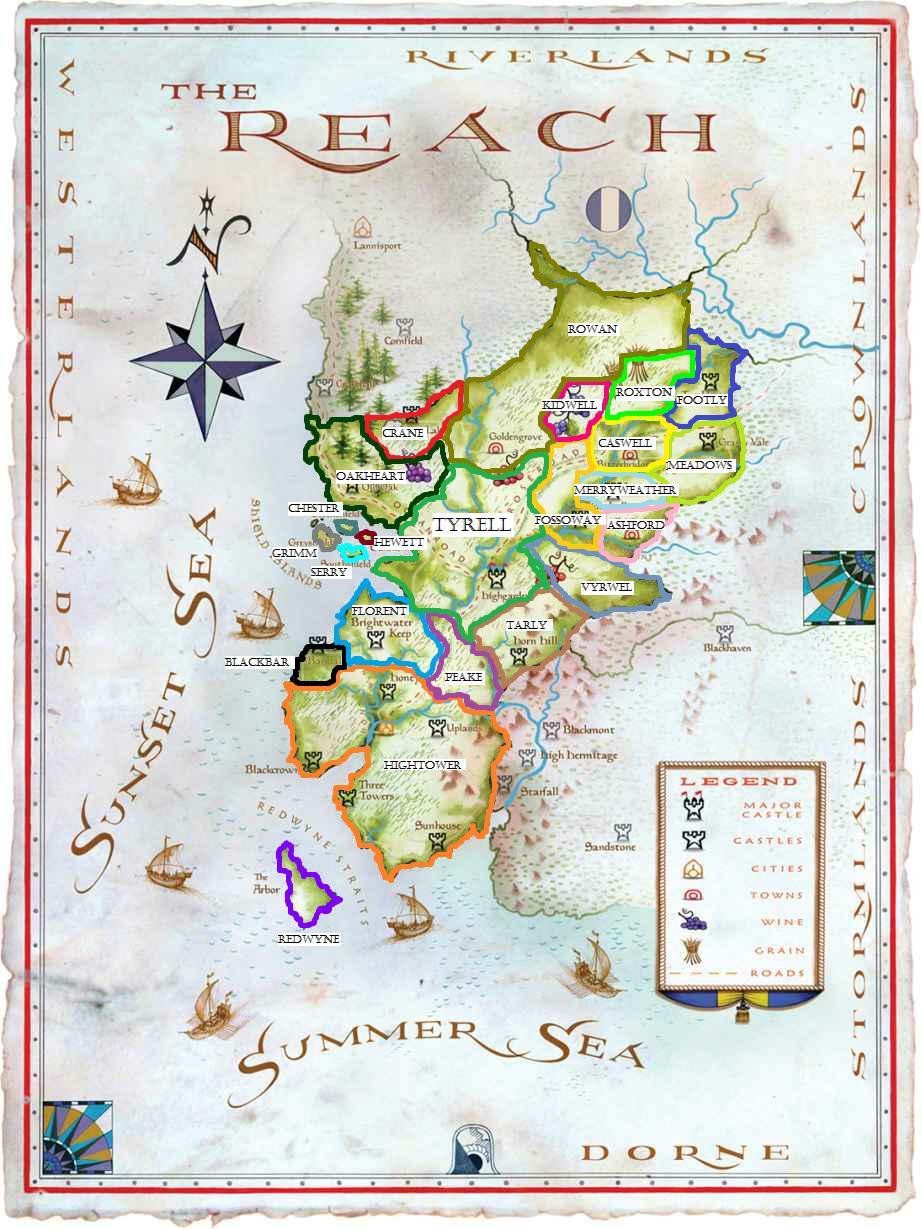
Politics of the Seven Kingdoms: Part VII (The Reach)
Hey folks! If you’d like to read my essay on the politics of the Reach collected together in one place, it’s now up on Tower of the Hand here. Check it out!
So, Bran the Builder helped build Storm’s End. Do you think this was really him or some other guy, but that they ended up giving credit to the famous builder? Also, if this was truly Bran the Builder, what was he doing so far South? Are we ever going to find more about this random Stormlands-North relationship?
Well, if the legends about the Hightower are true, Bran the Builder also spent some time in Oldtown, so it’s not impossible.
Do you think the north, with its history of ironborn raids and wildling invasions, would have a militia system in place? Or would that undermine the nobility? I could see the south blocking such a thing with their culture rooted in knighthood and an elite military caste. And does the pike and shield wall appear like a northern cultural thing handed down by the First Men or does it appear elsewhere?
A fyrd is not incompatible with feudalism – just ask the Anglo-Saxon earls, thanes, and kings – but the North seems to have a later feudal levy system as opposed to either the pre- or post-Alfred fyrd system.
Pikes are used elsewhere in Westeros – pikemen are mentioned in Rhaegar’s army, the pikemen of Lannisport are supposed to be well-trained, Catelyn sees tons of pikes at Renly’s camp at Bitterbridge, and on and on.
Shield walls are also mentioned elsewhere – Randyll Tarly discusses charging a shield wall at Storm’s End, the Ironborn use it at Torrhen’s Square, Stannis’ infantry try to form them when attacked on the southern bank of the Blackwater, the Unsullied fight in shield wall, Bennis the Brown tries to teach Ser Eustace’s peasants to fight in shield wall, etc.
hi maester steven, do you think that the saxon heptarchy and its later union in to the kingdom of england was grrm’s inspiration for the 7 kingdoms and their unification? thanks!
More than a little, yeah, although given what he did with the Faith of the Seven, I wonder if he already had decided to have everything go in sevens and then worked backwards from there.
Politics of the Seven Kingdoms: The Stormlands (Part I)
Politics of the Seven Kingdoms: The Stormlands (Part I)

credit to Ser Other-in-Law Introduction The Stormlands is something of an odd duck among the Seven Kingdoms neither one of the powerhouses like the Reach or the Rock, nor a failed state like the Riverlands, it putters around somewhere in the middle. At the same time, it is a kingdom which has enormous hidden potential, if only because something must explain how it managed to temporarily seize…
 RFTIT Tumblr Backup