I would not draw a direct line between what happens between Dany VIII and Dany X and the Nissa Nissa story, necessarily. GRRM describes it as a miracle, a sui generis event.
Dany is taken into the tent where the “shadows whirled,” which Mirri Maz Duur warns her about, saying that “once I begin to sing, no one must enter this tent. My song will wake powers old and dark. The dead will dance here this night. No living man must look on them.“
Dany’s child is slain by magic. While this could be due to the accidential exposure of Dany to whatever the hell was in that tent, Mirri Maz Duur takes credit and claims that Rhaego’s life was the cost for Drogo’s resurrection: “no, that was a lie you told yourself. You knew the price.” Then again, Mirri Maz Duur has been lying to Dany all along specifically to prevent the prophecy of the Stallion Who Mounts the World from coming to pass and to take revenge against Khal Drogo for enslaving her people.
Dany conducts a blood magic ritual based on whatever clues she’s gotten from MMD and from some unconscious urging. (Notably, when Dany awakes from her birthing bed, she’s already crawling towards her dragon eggs, with the words of “waking the dragon” ringing in her ears)
This ritual should not have worked on its own. As MMD says, although possibly trying to save her own life, “by itself, the blood is nothing. You do not have the words to make a spell, nor the wisdom to find them…loose me from these bonds and I will help you.”
This ritual definiitely involves the sacrifice of Mirri Maz Duur: ““it is not your screams I want, only your life. I remember what you told me. Only death can pay for life.”
This ritual also involves the ritual burning of Khal Drogo’s body and the three dragon eggs with him: “She climbed the pyre herself to place the eggs around her sun-and-stars. The black beside his heart, under his arm. The green beside his head, his braid coiled around it. The cream-and-gold down between his legs.” Note that Drogon’s egg came from Drogo’s heart.
This ritual also definitely involves a great heat as well: “she was the blood of the dragon, and the fire was in her. She had sensed the truth of it long ago…but the brazier and not been hot enough.” Remember, the sorceries of Old Valyia were “which were woven of blood and fire” (perhaps the words of House Targaryen are a secret riddle as to the source of their power?).
Finally, Dany also walks into the fire, bringing with her the blood of the dragon, the blood of Old Valyria.
Which elements of the ritual were necessary? Which were not? It’s hard to say when you’re talking about something that’s deliberately non-standard, and when the author is deliberately not systematizing magic in order to keep it magical.
What we can say is that this bears little resemblance to Nissa Nissa. Dany didn’t give a damn about Mirri Maz Duur, Drogo was already dead, whether the eggs were alive is difficult to say since they come from Asshai and that place’s relationship with life and death is borked. But certainly MMD didn’t sacrifice herself voluntarily, and it’s hard to say whether Drogo and the eggs count.
However…Dany might be considered a willing sacrifice.
Looking at the Lands map, I’m not sure on reflection that there is a land path to the Vale through Wickenden, actually.
See how the Mountains of the moon come down there to the sea behind Wickenden? If this is map is accurate (and it’s always an if with these things), then it may well be the case that there is no route there that an army could take, and that Wickenden’s links to Gulltown are purely naval in character.
Because I am seeing this described entirely incorrectly. It is NOT the case that the White Walkers didn’t harm wildlings – hell, when we see the Army of the Dead described in Sam I, they’re mostly wildlings – only that they didn’t attack them en masse. To quote Tormund:
“They never came in force, if that’s your meaning, but they were with us all the same, nibbling at our edges. We lost more outriders than I care to think about, and it was worth your life to fall behind or wander off. Every nightfall we’d ring our camps with fire. They don’t like fire much, and no mistake. When the snows came, though … snow and sleet and freezing rain, it’s bloody hard to find dry wood or get your kindling lit, and the cold … some nights our fires just seemed to shrivel up and die. Nights like that, you always find some dead come the morning. ‘Less they find you first. The night that Torwynd … my boy, he …’ Tormund turned his face away.
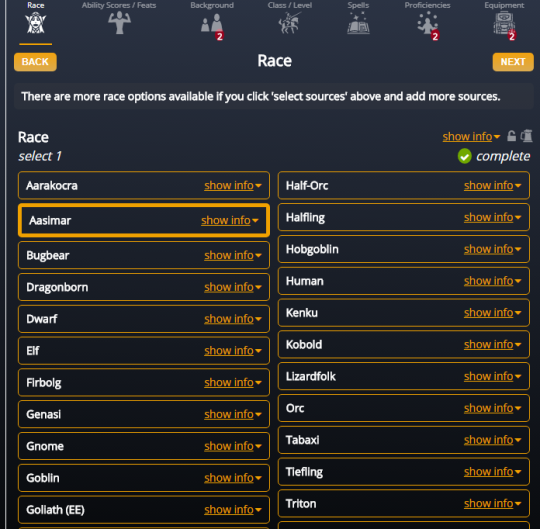
Have all you Dungeon and Dragon players heard of Orc Pub? It allows you to easily and freely create a DND character.
It informs you about each race, here you can see I’m remaking my Aasimar from a new game.
It can calculate all of your abilities for you if that’s something you have trouble with. I certainly have a hard time. Or if you’re super awesome and can do it by yourself there is a manual way to do it!
Basically it just helps you go step by step figure out what feats you might want, what alignment you might want, what comes items (weapons, armor, and gold etc) come with your character’s background and class.
Did I mention its FREE?
Right now there is a kickstarter to help make a mobile app, but right now I can easily transfer this info onto my character sheet!
For those who prefer the new edition.
:O
Sweet! I knew about this a while back, but its equipment database hadn’t been built out fully yet, so it was missing some stuff – Forgery Kit and Disguise Kit, if I recall correctly – that my character uses on a regular basis. And now that stuff is in there, so I’m good to go and will donate to the Kickstarter.
Meanwhile, D&D Beyond still only has like 6 Backgrounds in its database.
Yeah, I’ve been strugglin’ with this one for a while now. There’s zero indication in the books that we’re headed for a twist of this kind–even if we get the show’s reveal regarding the Others’ origins (which I have issues with, especially RE the timeline), that’s not the same thing as their intentions being misunderstood, let alone relatable or benevolent. A lot of the argument revolves around this line from GRRM:
“I mean the orc-like creatures who always do dress in black and…they’re really ugly and they’ve got facial deformities or something. You can tell that if somebody’s ugly, he must be evil…We don’t need any more Dark Lords, we don’t need any more, ‘Here are the good guys, they’re in white, there are the bad guys, they’re in black. And also, they’re really ugly, the bad guys.’ ”
This quote, however, doesn’t suggest that there are not embodiments of evil in ASOIAF. It just suggests that it’s lazy and problematic to have your villains always look evil and ugly and your heroes always look heroic and attractive. That’s why Cersei is beautiful, why Qyburn looks friendly, and why the Others resemble not Tolkien’s orcs but his elves. On the flipside, it’s also why Yoren is ugly, smelly, and grumpy while still being the truest of Night’s Watchmen and why Mance is mild-mannered and utterly average-looking despite his reputation (which precedes him by two books) suggesting a larger-than-life badass. And yes indeed, regardless of what he says on the subject, GRRM certainly hasn’t shied away from creating unambiguously monstrous characters; the closest one gets to sympathizing with Gregor is that he has migraines, and Euron… honestly, the Crow’s Eye just ends that particular argument.
It’s whatcha got inside that counts (GRRM being the world’s biggest Beauty and the Beast fanboy), and despite the Others being beautiful on the outside, they are pure death on the inside, as both Old Nan and GRRM’s pitch letter make unmistakably clear. To grab another relevant quote from the author, this time describing the Others to an artist:
“The Others are not dead. They are strange, beautiful… think, oh… the Sidhe made of ice, something like that… a different sort of life… inhuman, elegant, dangerous.”
So the appropriate reference point for the Others would be fairytales (and as much as Tolkien’s, Terry Pratchett’s Elves), which is why they steal children, kill livestock, toy with their human victims, and walk on the snow like Legolas. Or take this one:
“…and it is important that the individual books refer to the civil wars, but the series title reminds us constantly that the real issue lies in the North beyond the Wall. Stannis becomes one of the few characters fully to understand that, which is why in spite of everything he is a righteous man, and not just a version of Henry VII, Tiberius or Louis XI.”
And what does Stannis have to say about the role of the Others in the storyline?
“When the cold winds rise, we shall live or die together. It is time we made alliance against our common foe.”
The idea that a revelation is coming wherein humanity has misunderstood the Others’ intentions and that the latter are just trying to survive, responding to a pact being broken, or whatever else misunderstands the structure of the story. ASOIAF is not about people being bigoted against the Others and needing to recognize their commonality; that story’s in there, but it’s about the wildlings, not the Others. ASOIAF is about people having forgotten the Others. It’s not dehumanization, it’s mythology and the mists of time obscuring the horrible truth: the monsters in the children’s stories are real, and they’re back.
The argument goes that ending the story with a showdown with the Others (which, for the record, has been consistently set up throughout the series) would betray the anti-war message, but one of the key tenets of the anti-war message is that the war has made us fatally vulnerable to the Others. Take it from the man who’s going to let them in:
“Crow’s Eye, you call me. Well, who has a keener eye than the crow? After every battle the crows come in their hundreds and their thousands to feast upon the fallen. A crow can espy death from afar. And I say that all of Westeros is dying. Those who follow me will feast until the end of their days.”
That’s why it’s so important when Stannis makes the decision to turn his back on King’s Landing and go north to find “the foe I was born to fight.” That really loses its charge if the apocalyptic supernatural threat is not, in fact, an apocalyptic supernatural threat.
(Catelyn with child what-if, cont.) (2) on what gender the child was. I could easily see the Freys choosing not to kill him/her, and instead raise it to be a pro-Frey Stark. On the other hand, Tywin might have demanded the baby handed over to be raised as a ward of the Lannisters.
If Catelyn got pregnant in Catelyn II of AGOT, she would have given birth roughly around Catelyn I of ACOK. This has some pretty wild ramifications:
first and most obviously, she’s not going to Bitterbridge and Storm’s End having just given birth – Robb’s going to send someone else. This has substantial knock-on effects for Brienne of Tarth, which in turn reduces the odds that Jaime will be released.
Second, if her child is a boy, the Red Wedding loses a good deal of its political purpose, because the Stark/Tully forces will have a boy king to rally around.
Third, no way in hell Blackfish lets his niece and his king become Lannister prisoners.




 RFTIT Tumblr Backup
