Hey folks! With Jaime IV done, I’m a bit at loose ends – I need to do Druon Part II, but I’m not really feeling it, so I might go ahead with Dunk & Egg Part I or more ASOS chapters – but in the mean-time, we’ve gone some tumblrs:
This might be a better question for @warsofasoiaf, but I’ll try my best.
As far as swords go, we don’t have any mentions of sabres or curved swords in relation to Dorne. Curved swords do tend to be associated with Essos, so it’s possible that the Rhoynish brought that tradition to Dorne, but there’s no textual evidence for that. Where Dornish swords have been discussed – Dawn, for example – they’ve tended to be described in similar terms to the straight-bladed swords of the rest of Westeors.
The dominant weapon of Dorne is the spear, but there are a couple different variations:
Oberyn uses the long spear – “the spear was turned ash eight feet long, the shaft smooth, thick, and heavy. The last two feet of that was steel, a slender leaf-shaped spearhead narrowing to a wicked spike” – as a two-handed slashing and stabbing weapon. This seems to be a rather unusual way of fighting – probably associated with one-on-one combats – because we don’t see much in the way of Dornish fighting as pikemen.
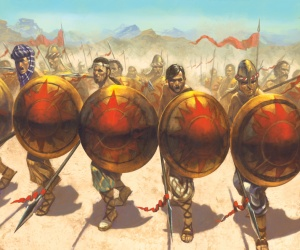
More commonly, the long spear is used in the Rhoynish fashion – “the Rhoynish warrior with his silver-scaled armor, fish-head helm, tall spear, and turtle-shell shield was esteemed and feared by all who faced in him battle” – one-handed with a round shield in close-formation, closer to the classical phalanx than the Macedonian.
However, there’s also lighter throwing spears – “the canny Dornishmen rained rocks and arrows and spears from the heights;” “many carried bundles short throwing spears” – which are used as javelins by both infantry and cavalry alike.
There are some other weapons which are also worthy of mention:
The Dornish are known for their recurve bows – “when the Dornishmen saw them coming, they spurred their own mounts, banners rippling as they rode…the double-curved Dornish bows they used so well from horseback” – which are used by infantry and cavalry alike.
As we can see from Dornish participation in various tourneys, we know that Dornish noblemen are also trained in the lance like the rest of their Westerosi peers.
In terms of armor, we have a couple different types used:
The Rhoynish smiths were especially adept at creating “suits of scale and plate.” So both heavier and lighter armors are available.
Oberyn prefers to wear lighter scale armor (“his shirt was armored with overlapping rows of copper disks that glittered like a thousand bright new pennies as he rode. His high gilded helm displayed a copper sun on its brow, and the round shield slung behind him bore the sun-and-spear of House Martell on its polished metal surface.”) in combination with some plate pieces (”The Red Viper was lightly armored; greaves, vambraces, gorget, spaulder, steel codpiece. Elsewise Oberyn was clad in supple leather and flowing silks. Over his byrnie he wore his scales of gleaming copper, but mail and scale together would not give him a quarter the protection of Gregor’s heavy plate”) to maximize his mobility.
Common Dornish soldiers are also known to wear “ring mail and crested helms.”
The one that comes to mind first is the “true knight” archetype, which is definitely one that influences quite a few characters: Brienne, Dunk, Ser Barristan, etc.
2: In the case where Viserys doesn’t take a second wife, wouldn’t there be a civil war between Rhaenyra and Daemon? Even if they were married, if they both think they are rightful ruler and the other is the consort, I have a hard time seeing them getting along long-term without the threat of the greens (and of course, the relationship did break down fairly quickly even *with* the threat of the greens).
I don’t think they’re particularly publicly announced – Jaime mentions a “royal raven” telling him to come to King’s Landing for his investiture, which suggests a measure of discretion before the ceremony – but I imagine the Lord Commander of the Kingsguard and the Grandmaester would know at the very least. So it’s possible Pycelle told Tywin ahead of time, but I think the larger point that Cersei was in the vicinity and could have attended stands.
Could be, but I don’t know whether their conflict would take the form of a civil war vs. assassination.
I think it’s a combination of a deep commitment to a poisonous ideology that sees intelligence as weakness and exalts brutality, and being very unaware of how his emotions are driving him. At the end of the day, Balon’s not rationally calculating the right move, he’s trying to purge himself of the feelings of failure and weakness from his last rebellion.

 RFTIT Tumblr Backup