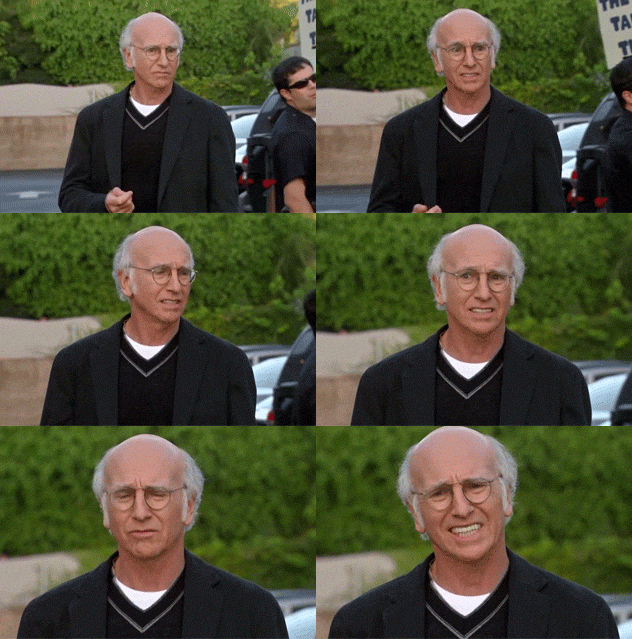
So I know we’re kinda supposed to feel a bit of schadenfreude over the Frey pie situation, but even if Manderly didn’t technically violate guest right, it’s still super fucked up. Is he due a bit of karmic retribution himself at some point, or does it even out as karmic retribution against the Freys?

According to GRRM by way of Old Nan, no:

“"It was not for murder that the gods cursed him,“ Old Nan said, "nor for serving the Andal king his son in a pie. A man has a right to vengeance. But he slew a guest beneath his roof, and that the gods cannot forgive.”

Wyman Manderly knows the old stories, so I’m absolutely sure that he planned his vengeance accordingly. 

As for karmic retribution, I’m pretty sure he’s planning to die.

Thoughts on the Disney Fox deal?

As an MCU fan, I’m happy that the Fantastic Four and their Rogue’s Gallery can be a part of the MCU. The X-Men films will take a bit of finessing to bring into the MCU, because 

  • A. I don’t think you want to lose the genre/experimental vibe they’ve been going with since Deadpool/Logan (otoh, the main X-Men films are not going in a good direction), and 
  • B. getting the place of mutants in the MCU right is critically important, because if you get it wrong you get Inhumans and no-one wants Inhumans.

However, I strongly disagree with arguments that the X-Men should be in their own universe.  Wolverine started as a Hulk antagonist, the X-Men met the Avengers in X-Men #9 and hung out with Spider-man all the time, various X-Men join the Avengers, etc. We know that these characters can work in the same universe because they have for a half-century. 

At the same time, as someone who doesn’t like corporate consolidation, I’m not super-thrilled about every part of the deal that doesn’t have to do with Marvel IP. 

You prefer Marvel over DC? Is there any particular reason for this?

I don’t think there’s a reason, per se. As I’ve said before, when I started reading comic books as a kid I did so through trade paperbacks or through random issues bought off of card tables on the sidewalk. And I read a decent bit of DC – I remember Knightfall quite well, Death of Superman less well – as well as Marvel.

But it was Marvel that I gravitated to: most specifically to Claremont’s run on X-Men and Captain America, although I did read a bit of Spiderman (although the line was in the throes of the Clone Saga at the time and I couldn’t make heads or tails of what’s going on) and some other stuff. 

As to why? I was a kid growing up in NYC, which meant that the Marvel Universe was happening right around the corner. So there was that instant feeling of recognition and familiarity that I just didn’t get from DC Comics, which has always preferred to keep its cities blandly abstract. 

RFTIT Tumblr Weeklyish Roundup

Hey folks! I’ve finished teaching for the semester, which means I’ve got a week and a bit clear to do some writing before final papers come in to be graded. So with any luck I should be able to finish Politics of Dorne Part III (currently at 1,000 words) and the next ASOS chapter before then. In the mean-time, we’ve got some stuff on the Tumblrs: ASOIAF: Why the Tyrells needed to link up with…

View On WordPress

I’m a bit confused about Knights as a social class. Were they all younger noble sons trying to make a living? How did they pay for their equipment? Could they own land or were they dependant on a master for their finances?

No. Knights were a particular section of the nobility, below the level of lord but above that of esquire. Indeed, one could argue that they were the foundational element of the nobility, since fiefdoms were made up of knight’s fees.

They paid for their armor usually in cash from the feudal taxes and rents that they extracted from their knight’s fee. 

And knights usually did “own” land – the aforesaid knight’s fee – although there were household knights or tourney knights or the like.