It’s a #aesthetic thing. Also shows up in the original On Stranger Tides, not the movie which doesn’t exist.
Author: stevenattewell
Thoughts on D&D’s reign of media terror extending to STAR WARS after the abomination that is Game of Thrones? Where does this leave the inevitable white supremacist wet dream of Confederate?
Well, Disney’s been known to can directors before…
What do you suppose is the technology level of Skagos? Are they like the wildling or the thenns, or closer to the northern mountain clans ?
I think they’re probably somewhere between the wildlings and the rest of the North, given that they have Lords of named Houses and named Holdfasts.
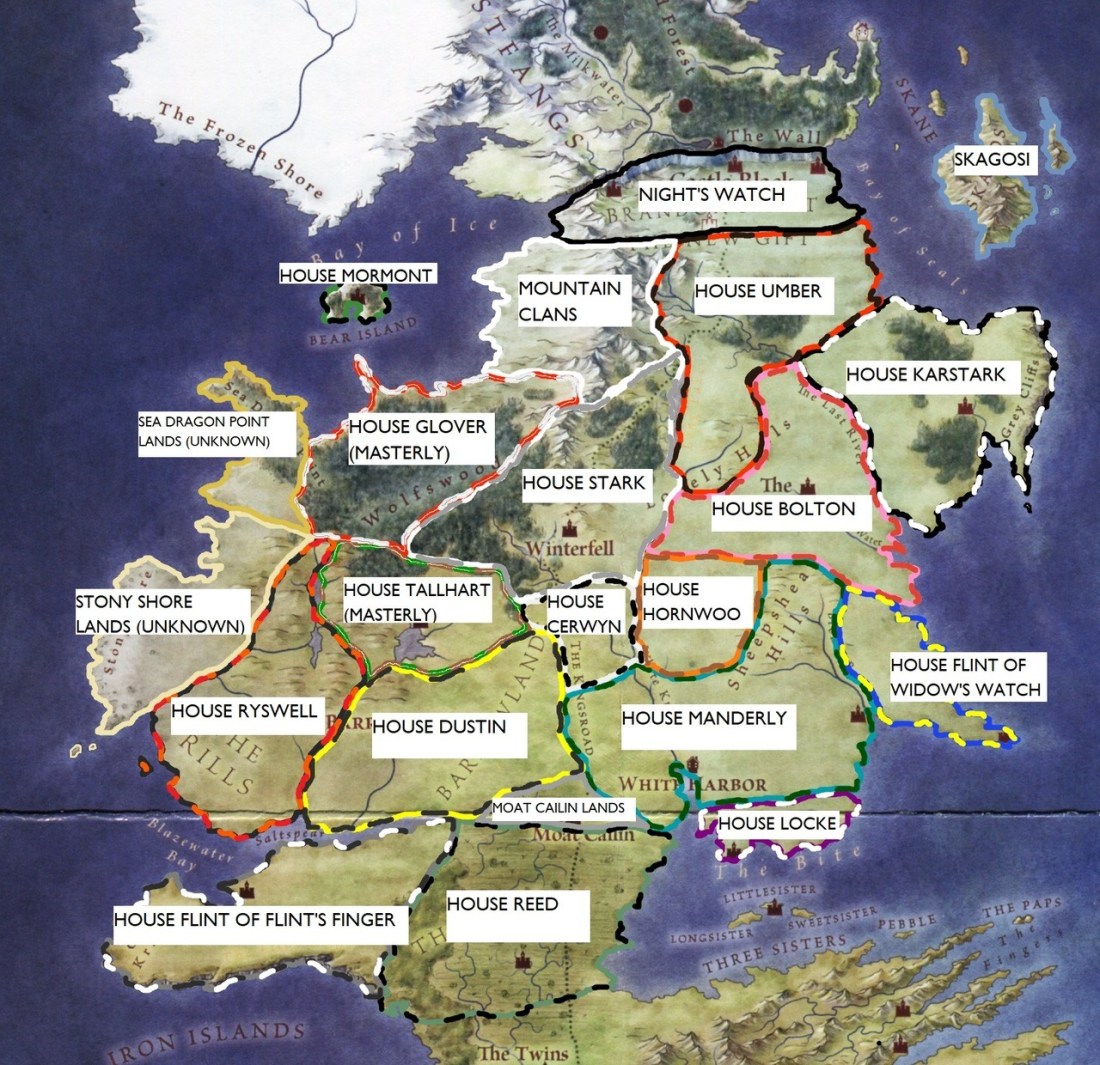
Hey, so here’s the political map of the North, I tried to make it as accurate as possible based on the text that we have.
Formidable! This looks pretty damn good; there’s a “d” missing from “Hornwood,” I think you could add in some of House Manderly’s vassals houses (the Woolfields of Ramsgate and the Sheepshead Hills), the Condons are vassals of the Cerwyns, you could add the Stanes of Driftwood Hall on Skagos, but that’s it.
Was Henry VIII an unusually strong king in English history?
Yes, although that’s largely because of what he inherited from Edward IV and Henry VII.
Are the Lannisters of Lannisport an “independent” house, like any of the other western houses (Brax, Crakehall, Marbrand…) or do they lack any rights those houses enjoy?
They’re a stlightly odd case, because they are a cadet branch, but a very old one, but also live really close to the seat of the main branch.
How do you think Maesters get assigned to a house? Does the house just ask the Citadel for a Maester and they sent one, or do you think it’s a more complicated process?
I think the Citadel sends them using its own system, which probably involves factors like what links the maester has (there’s probably a core of necessary abilities like ravenry and medicine at the very least), where the maester came from (note that maesters rarely serve in the kingdom they’re from, to avoid the temptation of bias for their former family), etc.
What are your thought on Runaways?
Haven’t finished Season 1 yet, but I like what I’ve seen so far.
And the comics are generally pretty good.
Whenever I see ASOIAF discussed in a meta sense, it always seems to be regarded as a deconstruction, and subsequent reconstruction to some, of a fairly abstract “standard fantasy”. I’ve got relatively little exposure to non-dark fantasy, so while I’ve got an idea of the tropes and/or cliches at work I haven’t seen them in action too much. Can you recommend a few that would help give insight into “standard fantasy” in action?
Well, there’s always been multiple variants of fantasy, which you can array on a spectrum from High Fantasy to Heroic Fantasy to Sword & Sorcery to Low Fantasy. When people talk about standard fantasy, they’re usually talking about either High or Heroic, and they’re usually talking about your Standard Fantasy Setting in some vaguely Medieval European direction.
Hopefully those TV Tropes pages should give you some examples, but you won’t go far wrong if you read a cross-section of Tolkien, Dungeons & Dragons novels, David Eddings, and Terry Brooks.
Is there a way in Westerosi society for somebody like Jakob Fugger to amass that kind of fortune?
Littlefinger managed it through massive corruption, embezzlement, and accounting fruad.
 RFTIT Tumblr Backup