Yes and yes.
Author: stevenattewell
How I Would Fix the SW Prequels

So I’ve been listening to School of Movies’ We Need to Talk About Anakin episode, and it reminded me that, while I’ve discussed this with friends and acquaintances in DMs, I’ve never actually written out this idea I had a while back for how you could fix the Star Wars Prequels.
Because in the wake of all the sturm und drang over TLJ, I feel like it’s worth noting that the failures of the Prequels were largely ones of execution rather than intent or conception and I think a very few changes could have made it a worthy addition to the larger universe.
Change #1: Make Anakin Older
No offense at all to Jake Lloyd, because why torture someone their entire life because they weren’t good at acting when they were nine years old (almost no one is any good at that age), but I think one of the major problems with the series was that Anakin starts out too young, which causes all kinds of character and world-building problems in all three movies. Instead of being 8-9 years old, Anakin should show up in Episode I as a teenager.
This one change does a lot:
- To start out with, it creates a better thematic parallel with the original trilogy (and now the new trilogy too) – we meet Anakin when he’s around the same age as Luke Skywalker in A New Hope, and around the same age as Rey in The Force Awakens. They’re all teenagers who dream of the stars but are held in place until something arrives to change their world forever.
- Next, it gives the audience a way into how the character is similar to and different from our other protagonists: like Luke, Anakin is a teenager scraping out a life on a backwater desert planet, and because he’s a teenager, and like Luke all Anakin cares about is space street racing (because American Graffiti). But whereas Luke is a good if slightly whiny kid with a decent home life, Anakin is a bit of a wild kid. He hates being a slave, hates that his master makes money off his talents but won’t ever let him win his freedom, throws fists when people say he’s a cheat, etc. You can already get the sense that he’s got a bit of the Dark Side in him already – this will help later on in the Trilogy, as I’ll explain in due course.
- After that, it makes his other relationships make more sense: instead of the creepy age gap which means that we start with Amidala as a teenager caring for a child which makes their relationship in Episode II harder to accept, the two meet as peers in a shared period of struggle, which promotes an instant bond and explains why both of them would be interested in rekindling the relationship a short few years later. Likewise, instead of Obi-Wan pretty much raising Anakin, they’ve got more of an older/younger brother dynamic which helps to explain why Obi-Wan would decide to and struggle with mentoring someone not that much younger than himself.
- Finally, it makes the Jedi Order no longer insane or evil. If an eight or nine-year old is too old to be trained, than the Jedi are basically stealing babies and raising them to be ascetic warrior-monks with no experience of the world. However, if Jedi are supposed to be trained from late childhood, so that they have control over their powers when the intense emotions of adolescence hit so as to not fall to the Dark Side or hurt people around them inadvertently, that seems like a sensible precaution.
Change #2: Bring the Sith in Earlier
I strongly believe that having the fall of the Republic political narrative be a central part of the Prequels was a good idea, since part of what you need to explain is why the Republic fell and the Empire took over. The execution, however, was less good. And part of that is that there’s a pretty hard swerve from local conflicts over tariffs and blockades and trade federations to the rise of the Emperor, so the initial reason for the Jedi to get involved in Naboo never makes much sense and the stakes of the conflict with the droid armies is too low to carry us through the trilogy.
So instead of going to Naboo to negotiate over trade, have Qui-Gon and Obi-Wan investigate whether the Sith are behind the rising Separatist movement. I would jettison the whole Rule of Two thing, because it doesn’t make sense that an entire Jedi Order of thousands of Jedi would think two Force-users are a galaxy-wide threat, and replace it with the idea that the Sith operate in independent cells of a master and two pupils (because Rule of Three) who go on to found their own cells, in a combination of pyramid scheme and underground organization, this hidden, omnipresent threat operating everywhere and nowhere at once.

This does a couple things:
- it better explains why the Jedi are so concerned with the Sith, and provides a longer-term explanation for the downfall of the Republic: rather than promoting the health of the Republic, the Jedi became obsessed with hunting down signs of Sith activity, which made different groups in the galaxy see their supposed defenders as violent religious fanatics, and allowed more subtle Sith like Palpatine to corrupt the Republic from the shadows. (And rising fear and hatred strengthens the Dark Side of the Force…)
- It gives a clear through-line from the trade conflict at Naboo to the Separatist/Clone War to the fall of the Republic: in each movie, the Jedi are looking to see whether the SIth are secretly behind some threat to the Republic. In Episode 1, Qui-Gon and Obi-Wan encounter Darth Maul, who seems to prove that the Sith were involved, but they don’t find out who his master was; in Episode 2, Obi-Wan and Anakin are fighting the separatist movement, which Count Dooku’s involvement “proves” to be Sith-inspired, and the Clone War kicks off with Sith groups popping up all over the galaxy; in Episode 3, the Republic falls to a military coup that could only succeed because of the military build-up.
- It provides better context for Anakin’s fraught relationship with the Jedi Order: Qui-Gon is convinced that the self-taught Anakin is the Chosen One because the threat of the Sith makes the prophecy that much more important, the Jedi Order don’t trust Anakin because they’re afraid that he’s a Sith infiltrator, and it gives a better reason for Anakin to turn against the Jedi if he comes to see them as paranoid and oppressive.
- And this also fits in with what a big part of Anakin’s arc should be about, without everything having to be about his romance with Amidala. If Anakin was already a teenage prodigy when the Jedi found him, he’s already started using the Force (although he doesn’t intiially know what he’s doing) and using his emotions to give him strength, and Anakin should be especially good at the very physical stuff that the Dark Side is strong in: using the Force to speed up his reaction time, shoving boulders out of the way during Pod Races, etc.
- And so when Anakin becomes a Jedi in his own right, he should start making the argument that “balance” means using both the Light and the Dark Sides of the Force (which is also a nice thematic parallel to both Luke and Rey). This should gain him some acolytes, especially during the Clone War when fighting Sith makes some Jedi fight fire with fire, which helps explain how Darth Vader is later able to hunt down almost the entire order, but it also gives the Jedi a reason to fear him and even Obi-Wan a reason to doubt him, and a central tension: will Anakin maintain his precarious balance or fall? (It also sets up a nice parallel once again: Anakin chooses the dark over the light, Luke the light over the dark, Rey is the synthesis.) It’s a hell of a lot better than him being a fledgling fascist or fridging his mother to give him a reason to go bad.
Change #3: Give Amidala More To Do
Speaking of the political plot, one of the things that would give the political plot more meaning for the viewer is to give a lot more of it to Amidala and have her be more active in it. While Amidala gets to do some stuff – in Episode 1 she calls for a vote of no confidence in the previous Chancellor, bringing Palpatine to power, and works out an alliance with the Gungans; in Episode 2 she’s attacked and doesn’t actually get to act against the rising militarization of the Republic, although she does get to fight on Geonosis (which is a bit of a thematic contradiction), and then everything else is the romance; and then in Episode 3, she’s not allowed to do much.
Rather than this mish-mash, I’d have Amidala’s main arc in the Prequels be the foundation of the Rebel Alliance: have her be actively whipping votes against the creation of a standing army and the granting of emergency powers in Episode 2 (good time to bring in Bail Organa and Mon Mothma earlier and have them do more) and doing more to uncover the behind-the-scenes machinations that are driving the conflict; have her try to uncover Palpatine’s crimes and bring him to justice in Episode 3, only to be too late, and decide instead to create the Rebel Alliance, etc.
This also gives a better explanation for why the romance between her and Anakin falls apart without the need for Tuskan ethnic cleansing or wanton child murder: as Anakin gradually falls to the Dark Side through a combination of “ends justify the means” and fear/resentment for the Jedi, Amidala moves in the opposite direction as she fights against this same mentality in the increasingly militarized Republic and begins to see Palpatine as the true threat.
Do you think the Arryn Kings of old ever tried to incorporate Maidenpool into their realm? I know there were some failed Arryn campaigns into the Riverlands, but seeing as how close the city is to Gulltown, the Vale must’ve been able to bear the full weight of its fleet on Maidenpool. Kinda like England and the Pale of Calais.
I could see it being tried, but I think the difficulty would be (similar to the Pale of Calais) that you’d have to supply and protect it by water, that it would be vulnerable to being cut off and surrounded, etc.
I really liked your economic development series and if I discovered them in time I would’ve liked to be in the discussion. I’d like to read an Essosi economic development series. Do you have any plans to do so? If not, I may try my chance on it but I am not sure if anybody would read it.
I don’t have any plans to do so, since the Free Cities at least are already quite economically developed for their era.
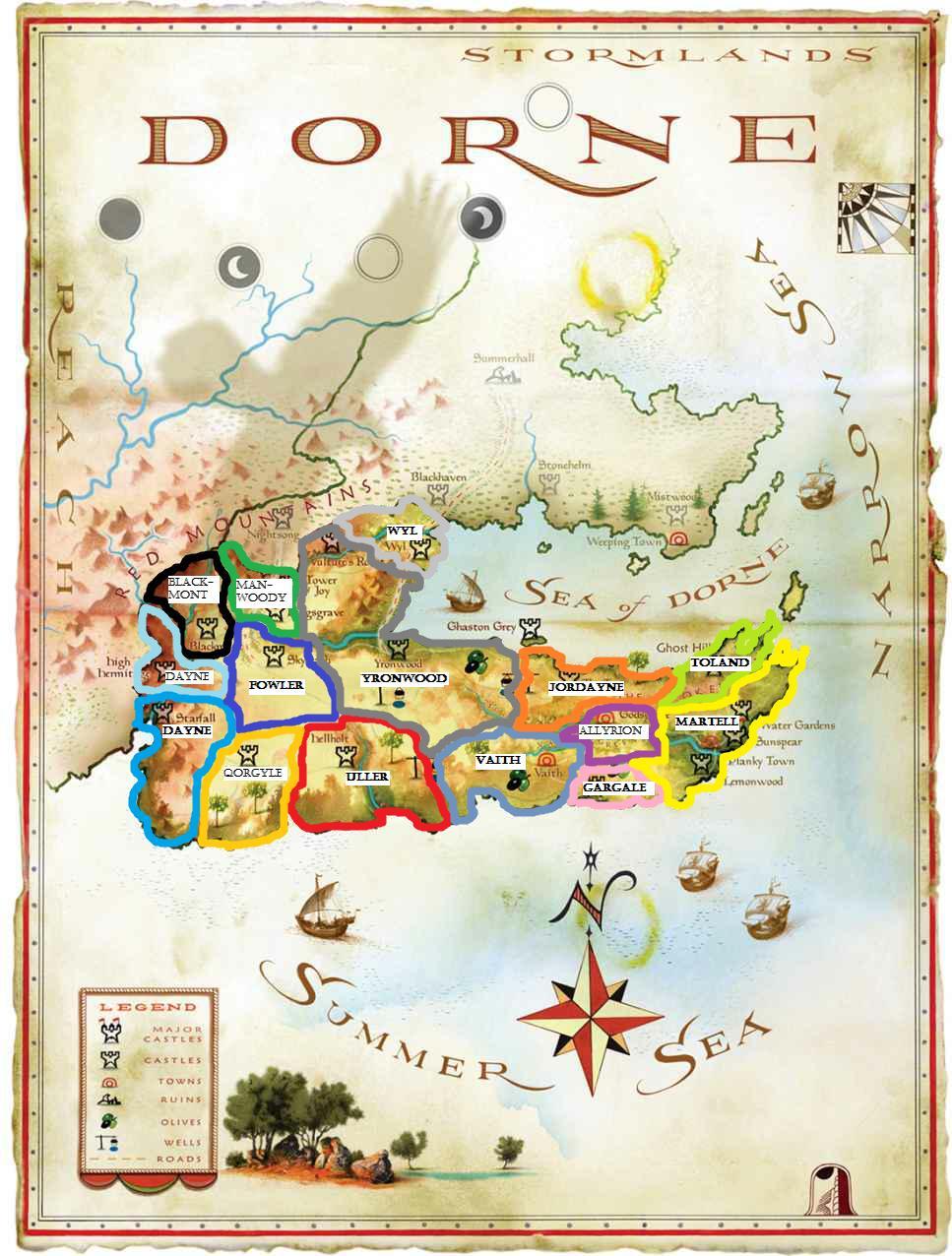
Politics of the Seven Kingdoms: Part IX (Dorne)
Hey folks! After a long delay on my part, I’ve combined and edited together the three parts of my Politics of Dorne essay, which is now up on Tower of the Hand…
Why didn’t Stannis/the new Baratheon regime utilise (at least in part) the Redwyne fleet to attack the Targaryen one & take Dragonstone, instead of building & crewing their own royal navy (presumably at least comparable in size) from scratch? Why not bring in Lannister, other Reach, & Vale ships too?
Because the Redwyne fleet’s loyalties were very dubious.
Regarding being Dany a foreign invader to Westeros, how did England view William I, James I, William III or George I? Was there any of that attitude about them? AFAIK there was some objection to William III, but was that because he was Dutch or because he was a Protestant?
I wrote a much longer version of this, but delted it because I was getting repetitious, so here’s trying for something more concise:
William I: did face quite a bit of opposition from the remaining Saxon Earls and the heirs of Harold Godwinson and the remaining members of the House of Wessex, but also from the Count of Boulogne (a former ally of his during the Conquest who was pissed off at the division of the spoils), King Sweyn of Denmark, King Malcom III of Scotland, and in his Continental holdings from King Phillip of France. His foreignness definitely played a role in the Saxon rebellions, but you have to put it into a complicated international context where Saxons might ally with Danes or Scots against Normans and other Saxons ally with the Normans against the Danes and Scots.
James I: Not really, except for conflict between James and Parliament over James’ desire to be recognized as King of Great Britain. James’ Scottishness was outweighed by the fact that he was the clear successor to Elizabeth and supported by her administrators, and also the fact that he was a Protestant (especially in the wake of the Gunpowder Plot). Not that there weren’t conflicts with the new King, but they usually had to do more with royal debt, taxation, and the prerogatives of Parliament vs. the King.
William III: I cannot emphasize how much this depends on where you’re talking about. William and Mary’s accession to the throne and the deposing of James II was way more popular in England than it was in Scotland or Ireland, hence why the various Jacobite revolts were based in Scotland or Ireland with only a minority of support in England. And this political conflict was directly linked to religious identity: James II’s Catholicism and support for Catholics in government was a major reason why he found support in Catholic areas of Scotland and Ireland, whereas William III’s Protestantism made him more popular in England. Indeed, when William landed in England as part of the “Glorious Revolution,” the motto on his banner (”Pro Religione et Libertate”) was understood by all to be referring to Protestant religion and Protestant freedom.
George I: more so than William III. William was Dutch, but his mother and wife were English and he himself could speak English, and his wife was an English Queen, so that militated against any such reaction. George’s English connections were more remote, and at least for the early part of his reign George couldn’t speak English. While this wasn’t a direct cause of the two major Jacobite revolts during his reign, the sense that George was a foreign monarch did probably contribute, at the very least to the increased participation of English Tories in the Jacobite uprising of 1715. However, later Jacobite risings in 1719 and 1745 really only drew their support from Scotland, suggesting it was something of a transient phenomenon.
Do you regret that Alejandro Jodorowsky didn’t get to make Dune?
Not really.
How would euron and roose react if they met the White walkers ? Are they too montstruos to be afraid ?
Well, I think Euron aspires to become something like the Great Other, so I don’t think fear would be his response.
Roose lacks most emotional responses, but I think he’d fight them for territory if for nothing else.
What do you think about the theory that Ned was the Knight of the Laughing Tree? I love the idea of it being Lyanna, but I found some of the reddit theories that it was Ned pretty persuasive.
I find those arguments the absolute opposite of persuasive. Indeed, I can’t really think of a theory that goes so completely against both the plain meaning of the text and the thematics established by the author.
 RFTIT Tumblr Backup