But Red Wedding 2.0 is going to happen at Riverrun, not the Twins.
Author: stevenattewell
How democratic was the Roman Republic? I understand it was a slave society, so the slaves were obviously not enfranchised. What about free Romans, who weren’t enslaved? Did the average person’s life change much when the Senate lost power and Augustus became emperor? And what, if anything, does it say about the US that people on both sides of the aisle are fond of citing the fall of the Roman Republic as a parable on the fragility of democracy?
Depends what period of the Republic you’re talking about. There were periods where the constitution changed to be more democratic, after the secessions of the plebs for example; there were periods where the constitution changed to be less democratic, such as after Sulla made himself dictator and rewrote the constitution to disempower the plebians.
As to how the average person’s life changed, it’s a bit tricky to say, in part because Augustus maintained the forms of the Republic, so that the Senate retained a good deal of influence for a long time. (Arguably even after the fall of Rome itself).
As to people in the U.S, that speaks to the enduring classical trend in American constitutional thinking since before the American Revolution.
How is Knighthood viewed and valued in the North? Especially for Northerners like Jorah receiving the honor? Shouldn’t it be regarded as a betrayal of the Old Gods, since knighthood is so tied the Faith?
I don’t think it is, since a good number of Northern knights are still followers of the Old Gods.
Overall, I think knighthood is seen as an ornamentation. Not negative, but not important either.
What are the odds that The Twins became a thin place after the Red Wedding?
Decent.
You are an adviser to Kaiser Wilhelm and half to give him ten pices of advice on what to do what are they
I mean, if it was me I would say “declare a republic then abdicate.”
But then again, I’m Team Smallfolk 4 Life.
People Must Live By Work Book Club: Week 5 (Chapter 4) – Lawyers, Guns & Money
Last week (although it was more than a week ago), the online book club of my new book (available to the reading public here and here) discussed the most controversial chapter of the book, which argues that the New Deal ended the Great Depression. This week, I’ll be discussing how direct job creation was suddenly abandoned during the debate …
People Must Live By Work Book Club: Week 5 (Chapter 4) – Lawyers, Guns & Money
Thoughts on the overall election results? Some Dems are depressed about the Senate and think we’re doomed but they took the House so I don’t think we’re doomed? What do you think
I think the doomed language is stupid.
We took the House, held our losses in the Senate in the worst damn map imaginable, won seven governor’s mansions, picked up quite a few trifectas and flipped some legislative chambers even where we don’t have the trifecta, expanded Medicaid in three states (and with the governors’ wins we’ll get Kansas and Maine on top of that), won a ton of criminal justice and voting rights reforms.
It wasn’t a perfect night. There were some real disappointments. There was some truly ugly fear-mongering and disenfranchisement, and the rules of the game are tilted such that a 9% popular vote margin, one of the biggest in the history of midterm elections, didn’t feel quite like the wave that it was.
But even in our disappointments, we made critical gains that will change things in the future: Beto didn’t win, but running a competitive race in Texas helped several Democrats over the line in the House and in the state legislature which wouldn’t have happened otherwise; Florida was a disappointment for the Senate and Governor’s races, but the passage of Amendment 4 means that the next election in Florida won’t have 10% of the population disenfranchised.
So take the win, even though it’s not perfect.
To quote Max Weber (and apologies for his 19th century language here):
Politics is a strong and slow boring of hard boards. It requires passion as well as perspective. Certainly all historical experience confirms–that man would not have achieved the possible unless time and again he had reached out for the impossible. But to do that, a man must be a leader, and more than a leader, he must be a hero as well, in a very sober sense of the word. And even those who are neither leaders nor heroes must arm themselves with that resolve of heart which can brave even the failing of all hopes. This is necessary right now, otherwise we shall fail to attain that which it is possible to achieve today. Only he who is certain not to destroy himself in the process should hear the call of politics; he must endure even though he finds the world too stupid or too petty for that which he would offer. In the face of that he must have the resolve to say ‘and yet,’—for only then does he hear the ‘call’ of politics.
What’s a confessor? In the real world it’s like, a holy person (like King Edward -1) or a priest who administers the eponymous sacrament. But how would a secular nobleman become one of these, as per Larys Strong’s first court post? Also, I thought a septa was mentioned somewhere as a princess’ confessor. The name septa suggests a female septon, but they act more like nuns than priestesses from what we see in the text. Maybe they’re something like Roman Catholic deacons, but more powerful?
Good catch!
In Westeros, a confessor seems to have a grislier, secular purpose:
The entrance to the dungeons proper was at ground level, behind a door of hammered iron and a second of splintery grey wood. On the floors between were rooms set aside for the use of the Chief Gaoler, the Lord Confessor, and the King’s Justice.
And for that task, Ser Ilyn Payne was singularly ill suited. As he could neither read, nor write, nor speak, Ser Ilyn had left the running of the dungeons to his underlings, such as they were. The realm had not had a Lord Confessor since the second Daeron, however…
The girls became handmaids to Princess Rhaenyra, whilst their elder brother, Ser Harwin Strong, called Breakbones, was made a captain in the gold cloaks. The younger boy, Larys the Clubfoot, joined the king’s confessors.
My reading of the above text is that The Lord Confessor was in charge of torturing prisoners in the royal dungeons, to elicit confessions. Which fits Larys’ track record as a pragmatic, if not ruthless, politician.
Do you think Ned was ever offered knighthood when he was growing up in the Vale?
Maybe? It could be that Vale knights would particularly insist on the link between the Seven and knighthood, given their cultural traditionalism on everything else, as opposed to Robert who clearly didn’t give a damn when it came to knighting worshippers of the Old Gods.
So I was in a D&D Character Creation Mood the other night…
Due to a combination of listening to some of @jewishdragon‘s sea shanties and reading Xanathar’s, I decided to build myself a pirate by combining the Bard College of Swords (swordplay and shanties for my spellcasting focus, natch) and the Rogue Swashbuckler Archtype, and of course Sailor Background.
I’m liking how this looks: I’ve got some really fun combat potential with Booming Blade, Blade Flourish, Fancy Footwork, and Rakish Audacity, I’e got Vicious Mockery for the Curse of Monkey Island style points, Expertise in Acrobatics and Stealth for whether I want to be flashy or sneaky, and the classic Bard spells.
The only thing remaining is picking my character’s race, and Tiefling just fits too well…
At which point I realize that I’ve basically reverse engineered Nightcrawler.
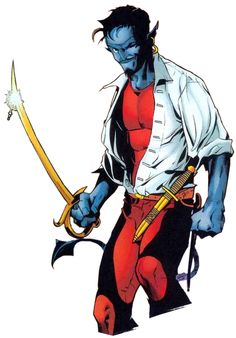
Now all I need to do is get a DM to agree to let me use Misty Step as one of my Tiefling Infernal Legacy spells and I’m set.
 RFTIT Tumblr Backup