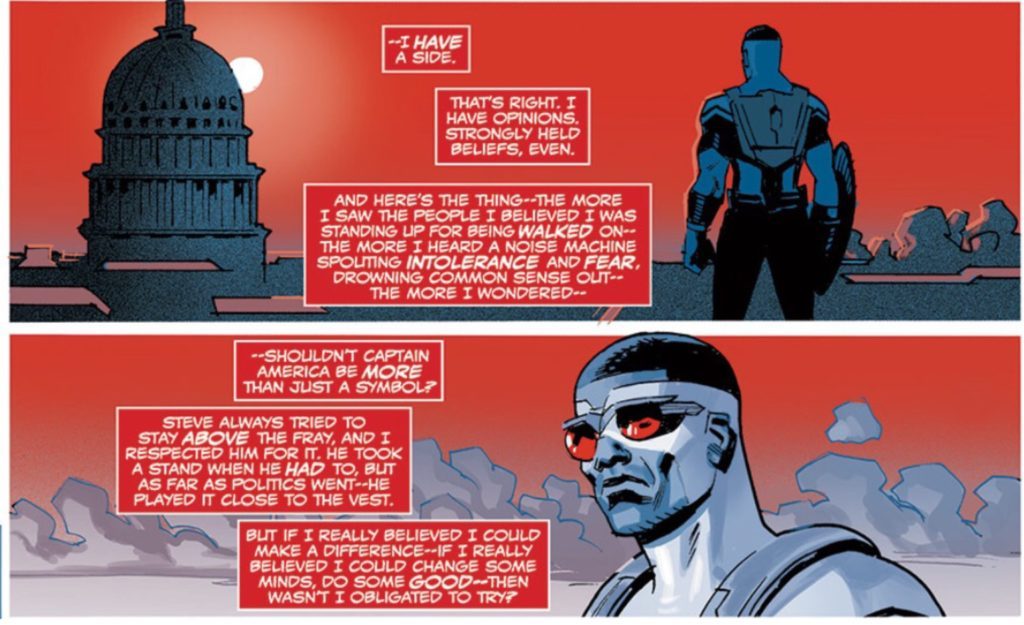
The problems begin far earlier than Spencer’s controversial retcon of Steve Rogers as a secret Nazi (HYDRA-Cap) in Captain America: Steve Rogers #1. In 2015, Spencer launched his first Cap book: Captain America: Sam Wilson #1, in which Sam Wilson (formerly the Falcon), took on the name while Steve was incapacitated. The opening conflict of CA:SW was premised on the idea that until Sam took over, Cap was non-partisan—is; Cap had no political stance. From here, the narrative struggles with whether it’s right that Sam-as-Cap is partisan, insofar as a superhero rescuing border crossers from white terrorists is “partisan.”
The trouble is that this narrative is hinged on the idea that until now, Cap was not political. Apart from being historically untrue, it speaks to a greater failure in recognising that everyone is political. The privilege to believe you can be apolitical is particular to a demographic like Nick Spencer’s. These people are exnominated, a term coined by Roland Barthes to describe how privileged identities are unnamed because they are the norm. The exnominated can believe that their race, ethnicity, gender, sexuality, bodies, and ideologies are “neutral.” For those of us outside the exnominated—anyone who is “other” in some way—our every action and inaction is, whether we like it or not, read as political. This is how the term “identity politics” arises, because only the non-privileged have a visible “identity,” and its existence is treated as political. Because we have been forced to recognise how our everyday is political, we recognise that the same is true of the exnominated. Not only is Captain America always-already political (come on, his name is “Captain America”), Steve Rogers, like every one of us, is always-already political. To believe otherwise is simply ignorant. It results in a fundamental flaw in the foundation of Spencer’s Captain America books and a lack of social understanding that is necessary for good writing.
To agree to the very premise that someone is apolitical is to validate the power structures that hold these people above others. To believe that one’s privilege is “neutral” is to misidentify oneself in the middle of a political spectrum, with marginalised people at one extreme and, inevitably, those who stand for the elimination of marginalised people at the other. This is how a mistake like HYDRA-Cap happens. First, Spencer asks us to agree to the flawed premise that Sam Wilson is more political than Steve Rogers. To do this, we must ignore Steve’s outspoken leftist leanings since the Silver Age and assume that neutrality is both possible and in-character. If we have agreed in Captain America: Sam Wilson that Steve is “neutral,” Steve’s political identity is hollowed out for a Nazi origin story in Captain America: Steve Rogers #1. Nazism becomes a reasonable part of the spectrum, and it happens because Spencer has built this narrative logic into his work from the beginning.
Read more in
^ Big yes to everything here.
For historical examples as to why Naja is right and Spencer is wrong, see here.
For more on this topic, see here.

 RFTIT Tumblr Backup